

Published as part of Suicide Prevention Awareness Month, which marks World Suicide Prevention Day annually on September 10th.

Talking about suicide remains difficult. The fear of saying the wrong thing, not knowing how to react, or that asking about suicide might somehow trigger suicidal thoughts in someone else often leads family, friends, and colleagues to avoid the subject.
However, when faced with someone in intense psychological distress, reaching out, asking, and listening can be an important first step.
You don't need to be a mental health professional to recognize signs of distress and offer initial support. It is, however, essential to know your limits and facilitate access to specialized care.
A complex and multifactorial public health issue
Suicide is a major public health issue. It is estimated that approximately 720,000 people die by suicide worldwide each year - 1 death every 43 seconds, making it the 3rd leading cause of death among 15 to 29-year-olds. For every person who dies by suicide, it is estimated that more than 20 others attempt it, with consequences for the individuals themselves, their families, and their communities (World Health Organization [WHO], 2025).
Recent trends reveal worrying signs: in the European Union, the downward trend in suicide mortality has stalled, with an increase recorded between 2021 and 2022. In Portugal, deaths by suicide also increased between 2021 and 2023, as well as emergency calls related to high-risk behaviors, specifically suicide attempts (around 39% between 2019-2021). These data are concerning, but they underestimate the scale of the problem, as many attempts are not recorded by services (Eurofound, 2025).
Understanding suicide requires, first and foremost, avoiding simplistic explanations. Suicidal behavior generally does not result from a single cause, but from a dynamic interaction between clinical, psychological, social, relational, and contextual factors throughout life. Depression, substance use, suicidal ideation, and previous attempts can increase risk; economic or work-related difficulties, isolation, adversity and trauma, discrimination, violence, physical illness, and chronic pain can increase vulnerability (WHO, 2025; Favril et al., 2023).
None of these factors, in isolation, constitutes a direct cause. Suicide risk is dynamic and depends on circumstances, personal history, lived suffering, and the resources available at any given moment. Rather than seeking a single explanation, it is important to understand what the person is experiencing, what is intensifying their suffering, and what support can contribute to their safety.
Is thinking about suicide the same as wanting to die?
Not necessarily. Thoughts about death and suicide can take different forms, intensities, and meanings, ranging from the desire for suffering to end without the intention of causing one's own death, to passive thoughts of death (such as wishing to fall asleep and not wake up) or more explicit ideation, with or without intent, planning, or preparatory behaviors (NICE, 2022).
Having suicidal thoughts does not mean an attempt will occur, but any manifestation should be taken seriously and understood within its context. A verbalization of suicide does not necessarily represent a final decision: it is a sign of distress that requires attention (Teismann et al., 2024). During a crisis, a person may feel trapped, withdraw from others, and struggle to see alternatives to suffering that feels intolerable (Melzer et al., 2024). Intervention should aim to increase safety, reduce isolation , and facilitate access to the necessary support.
Myths and facts about suicide
Some myths can lead to the dismissal of suffering and delay seeking help (Homan et al., 2026; Favril et al., 2023; Polihronis et al., 2022). Knowing the facts allows for a safer response.
Myth: Asking about suicide puts the idea into a person's head.
Fact: Asking directly and with care does not increase suicidal thoughts or behaviors; it can make it easier to express distress and seek support.
Myth: People who talk about suicide won't actually do it.
Fact: Any communication about suicide should be taken seriously as a potential sign of distress and risk, rather than as mere "attention-seeking."
Myth: People who want to die cannot be helped.
Fact: A suicidal crisis is neither inevitable nor irreversible. An appropriate response can increase safety and facilitate access to help.
Myth: Suicide only happens to people with mental illness.
Fact: Mental health disorders may increase risk, but they do not explain suicidal behavior on their own. Social, relational, and contextual factors can also contribute to vulnerability.
Myth: If the person seems better, the danger has passed.
Fact: An apparent improvement does not guarantee that the crisis is over. Follow-up and contact remain important, especially after an attempt.
Warning signs
It is important to be vigilant, especially when these signs have appeared recently, are intensifying, or represent a significant change in the person's usual behavior:
- In what the person says: talking about wanting to die or disappear; expressing hopelessness or having no reason to live; feeling like a burden to others; repeatedly referring to death or suicide.
- In what the person does: seeking information about ways to die or access to lethal means; engaging in preparatory behaviors; saying goodbye unexpectedly; giving away important personal belongings; withdrawing from people and usual activities; increasing alcohol or substance use; or exhibiting impulsive or risky behaviors.
- In terms of what a person feels or shows: intense suffering; marked changes in mood or sleep; anxiety or agitation; increasing isolation.
None of these signs, on their own, can predict a suicide attempt. However, they are reasons to reach out, ask directly, and try to understand what is happening. If there is an expression of suicidal intent, a plan, or immediate danger, you must act without waiting for other signs to appear.
Psychological First Aid: what is it?
It is a human, practical, and supportive response to a crisis situation. It seeks to reduce immediate distress, identify needs, and facilitate access to appropriate support, while respecting the person's dignity and culture (WHO, War Trauma Foundation & World Vision International, 2011).
In the event of a potential suicidal crisis, it does not replace specific safety measures, professional assessment, or specialized care when needed (NICE, 2022). The initial response can be organized into three principles: look, listen, and link.
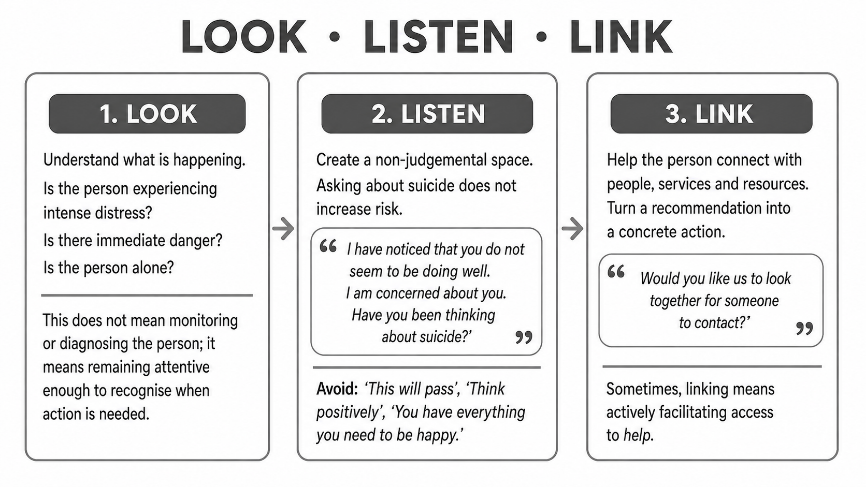
If someone tells me they are thinking about suicide, what should I do?
- Acknowledge the seriousness of the situation and try to stay calm: Be available, even if you don't fully understand what the person is going through.
- Ask directly: “Are you thinking about suicide?” Try to understand if there is an intention to act, a plan, or immediate access to means to harm themselves. It is not your job to assign a “risk level,” but to recognize the danger and promote safety.
- Listen without judging, minimizing, or trying to solve everything. Avoid interrupting, challenging how the person feels, or using phrases like “this will pass.”
- Explain that it may be necessary to involve others to ensure safety. You can say: “I want to respect your trust, but if I think you are in danger, I will need to seek help with you.”
- In the face of immediate danger, do not leave the person alone. Seek urgent help and, if it can be done safely, reduce access to medication, objects, or other potentially lethal means.
- Help take the next step: Ask: “Shall we call together?” or “Can I stay with you while you talk to someone?” Facilitate contact with a trusted person, a professional, or a support service.
Is it possible to create a safety plan?
Beyond the immediate response to a crisis, it is important to prepare in advance the steps to follow in the event of a new deterioration. This is the goal of the Safety Planning Intervention: a brief and collaborative safety plan, developed when the person is better able to reflect and make decisions (Stanley & Brown, 2012).
The plan is organized into six steps:
- Recognize the warning signs.
- Identify personal strategies for coping with a crisis.
- Reach out to people or places that provide connection and distraction.
- Identify people to ask for help directly.
- Define the professionals and services to contact.
- Make the environment safer by reducing access to potentially lethal means.
The safety plan does not replace clinical assessment and should not be used as a standalone response. It should be part of a more comprehensive intervention, tailored to the person's age, needs, and context (NICE, 2022).
After a crisis: stay connected.
The need for support continues beyond the creation of a plan and the most intense phase of the crisis. Brief interventions that include follow-up contacts are associated with a modest but significant reduction in further suicide attempts (Homan et al., 2026).
For family and friends, staying connected can mean simple gestures, such as asking "How are you today?" or saying "I was thinking of you." The important thing is that support does not disappear after the acute phase of the crisis.
What is important to remember?
If you are worried about someone, reach out, ask directly, listen without judgment, help promote safety, facilitate access to support, and stay in touch.
You don't need to find the perfect words. Psychological First Aid is not a substitute for professional care, but it can facilitate the first step between suffering and getting the right help.
What if it's me?
If you have been thinking about your own death or suicide, you may be experiencing suffering that is difficult to bear. You don't need to solve everything that brought you here right now. The priority is to get through this moment safely and allow others to help you.
Try not to be alone. Contact someone you trust and explain, as clearly as you can, what is happening. You don't need to tell them everything or find the right words. You can start by saying:
“I don't feel safe being alone right now. I need you to stay with me.”
or:
“I am thinking about suicide and I need help.”
Stay away from medications, objects, or other means you could use to hurt yourself. If possible, ask someone you trust to stay with you and help make your environment safer.
If you feel you cannot keep yourself safe, seek urgent help. The first step can simply be saying: “I need help now.”
Where to find help: support contacts in Portugal
- 1411: National Suicide Prevention and Psychological Support Line
- SNS 24: 808 24 24 24: Psychological Counseling Service.
- 112: Emergency: in the event of immediate danger, an ongoing attempt, or another emergency situation.
The role of organizations and mental health
Psychological distress does not necessarily stay outside the workplace. While they do not replace health services, organizations can help by recognizing signs of distress, reducing risks, facilitating the search for help, and ensuring an appropriate response to a crisis.
The guidelines from the World Health Organization and the International Labour Organization (2022) highlight three areas of action:
- Prevention: reducing psychosocial risks, training managers to recognize warning signs, and promoting a culture where asking for help is natural.
- Response: providing clear support channels, preparing managers for safe conversations, and defining procedures for urgent situations.
- Postvention: after an attempt or death by suicide, communicating carefully and providing psychological support to teams, with special attention to those closest to the individual.
Entities that provide mental health support to companies can strengthen this response through training, continuity of care, and the promotion of a culture of psychological safety.
Note: This content is for informational and psychoeducational purposes and does not replace a psychological, psychiatric, or medical evaluation. In the event of immediate danger or a medical emergency, call 112 or go to an emergency department.
References
- Eurofound. (2025). Mental health: Risk groups, trends, services and policiesPublications Office of the European Union. https://doi.org/10.2806/1616679
- National Institute for Health and Care Excellence. (2022). Self-harm: Assessment, management and preventing recurrence (NICE Guideline NG225). https://www.nice.org.uk/guidance/ng225
- Polihronis, C., Cloutier, P., Kaur, J., Skinner, R., & Cappelli, M. (2022). What’s the harm in asking? A systematic review and meta-analysis on the risks of asking about suicide-related behaviors and self-harm with quality appraisal. Archives of Suicide Research, 26(2), 325–347. https://doi.org/10.1080/13811118.2020.1793857
- Stanley, B., & Brown, G. K. (2012). Safety Planning Intervention: A brief intervention to mitigate suicide risk. Cognitive and Behavioral Practice, 19(2), 256–264. https://doi.org/10.1016/j.cbpra.2011.01.001
- World Health Organization. (2025). Suicide worldwide in 2021: Global health estimates. https://www.who.int/publications/i/item/9789240110069
- World Health Organization, & International Labour Organization. (2022). Mental health at work: Policy brief. https://www.who.int/publications/i/item/9789240057944
- World Health Organization, War Trauma Foundation, & World Vision International. (2011). Psychological first aid: Guide for field workers. World Health Organization. https://www.who.int/publications/i/item/9789241548205