


All articles
Artificial intelligence: emotional support or a false sense of security?
Some conversations are hard to start. Saying “I’m not okay” out loud can be difficult, especially when we don’t quite know what is going on with us or we fear being judged. Perhaps that is why so many people have begun turning to an unlikely listener for emotional support: artificial intelligence.
Available around the clock and able to reply within seconds, chatbots have become a kind of digital confidant. Some people use them to organise their thoughts, rehearse a difficult conversation, ask for relationship advice or simply vent after a particularly heavy day. They need no appointment, never interrupt and always seem to have an answer ready (and a kind one, at that!).
This availability can be comforting. But it also raises an increasingly important question: when we turn to artificial intelligence to talk about anxiety, loneliness or sadness, are we simply using a tool, or are we handing it a role it was never designed to play?
A space where it feels easier to talk
Turning to technology for support is no accident. Finding psychological help remains difficult for many people, whether because of cost, a shortage of professionals, long waiting times or the stigma that still surrounds mental health. According to the World Health Organization, more than a billion people live with a mental health condition, and a large proportion do not receive the care they need.
Against this backdrop, the appeal of a chatbot is easy to understand. It is there the moment distress sets in, responds without a hint of impatience and lets us speak without the embarrassment we sometimes feel in front of another person. For someone who has never sought psychological support, typing into a screen can feel like a simpler, safer first step.
The very structure of the conversation reinforces this feeling. Chatbots can produce reassuring replies, ask questions and recall details mentioned earlier. They may tell us that what we are feeling is understandable, or suggest we pause for a moment to breathe. The language sounds empathetic and, at times, can bring genuine relief.
That relief should not be dismissed. Writing about how we feel often helps give shape to confusing emotions. A digital tool can be useful for preparing for an appointment, listing our worries, finding different ways to approach a problem or turning scattered thoughts into clearer questions.
Even so, a conversation that sounds human is not necessarily a human relationship.
Simulating empathy is not feeling empathy
A chatbot does not worry, does not truly know the person it is talking to and does not understand a life story the way a mental health professional does. It generates responses based on patterns in language. Even when the words seem caring and personal, there is no awareness, clinical intuition or emotional accountability behind them.
This difference can be easy to forget, especially in the middle of an emotional conversation. When someone feels lonely or vulnerable, an immediate and warm response can create a powerful sense of closeness. Little by little, the chatbot may stop being seen as a tool and come to take the place of a confidant, a friend or a therapist.
This is where one of the main risks lies. Artificial intelligence tends to mirror the tone of the conversation and often validates whatever the user says. That validation may feel good, but feeling understood is not the same as receiving appropriate guidance. A good therapist does more than simply agree. They ask difficult questions, point out contradictions, take the wider context into account and know when it is time to intervene, to refer someone on or to call in additional help.
Artificial intelligence can fail at precisely these moments. It may misread a situation, reinforce a hasty conclusion or present incorrect information with great confidence. Nor can it see facial expressions, hear changes in someone’s voice or know everything that was left unsaid. In a crisis, these details can make all the difference.
The American Psychological Association has warned about this gap between how chatbots are being used and what they were built for. Although many people already turn to these tools for emotional support, most general-purpose AI systems were not developed to provide mental health care. Nor are they subject to the same rules, duties and oversight mechanisms that apply to psychologists, psychiatrists and other health professionals.
The risk of an overly convincing answer
One of the most delicate aspects of artificial intelligence is the way it presents its answers. A mistake voiced with hesitation invites doubt; a mistake explained clearly, coherently and confidently can sound like the truth.
In mental health, this is particularly dangerous. A chatbot may turn an ordinary difficulty into a possible diagnosis or, conversely, play down signs that deserve professional attention. It may offer interpretations of family relationships, encourage impulsive decisions or suggest strategies that are ill-suited to that person’s situation.
There is also the risk of emotional dependence. If talking to artificial intelligence starts to feel easier than dealing with real people, users may begin to avoid friends, family or professionals. A tool that initially helped ease loneliness may end up deepening it.
Human relationships are more demanding. They require us to wait, to listen, to work through differences and to accept that the other person will not always say exactly what we want to hear. Yet it is precisely these imperfections that make real connection possible. A chatbot can reproduce the outward signs of attention, but it cannot offer reciprocity, presence or genuine care.
This does not mean that every emotional use of artificial intelligence is harmful. It simply means we need to recognise where the tool’s usefulness ends and where an expectation it cannot meet begins.
A tool, not a therapist
Used within limits, artificial intelligence can play a helpful role. It can help someone write down what they would like to say in an appointment, suggest questions to ask a professional, explain general concepts or help build a self-care routine. It can also serve as a starting point for finding reliable information.
But it should not diagnose, interpret psychological tests or decide whether someone needs treatment. Nor should it be anyone’s only source of support in a crisis, or a substitute for meaningful relationships.
Some signs deserve attention: spending more and more time talking to the chatbot; hiding that use from others; consistently choosing artificial intelligence over contact with other people; feeling anxious when the tool is unavailable; or making important decisions based solely on its answers. In these cases, it may be time to pause and seek a human perspective.
A simple rule of thumb can help: use artificial intelligence to prepare for a conversation, not to replace it. It can help us find the words, but, whenever needed, those words should reach someone who is able to listen, understand the context and take responsibility for the support they provide.
Technology can accompany, but it cannot care alone
The debate on artificial intelligence and mental health does not have to be split between unbridled enthusiasm and outright rejection. Technology can broaden access to information, support professionals and make some first steps easier. At the same time, it needs clear boundaries, data protection, independent research and rules that put people’s safety ahead of the time they spend on a platform.
This Mental Health Month, perhaps the most important question is not whether a machine can talk like a therapist. It is whether we are creating the conditions for everyone to be truly heard by other people.
When someone turns to a chatbot because they have no one else to talk to, the problem does not lie with technology alone. It also lies in loneliness, stigma, the cost of care and the difficulty of accessing specialist support. Artificial intelligence may temporarily ease some of these gaps, but it does not close them.
A chatbot can reply at any hour. It can suggest exercises, reframe thoughts and find comforting words. What it cannot do is be truly present. And in mental health, that difference remains essential.
Published as part of Suicide Prevention Awareness Month, which marks World Suicide Prevention Day annually on September 10th.
Talking about suicide remains difficult. The fear of saying the wrong thing, not knowing how to react, or that asking about suicide might somehow trigger suicidal thoughts in someone else often leads family, friends, and colleagues to avoid the subject.
However, when faced with someone in intense psychological distress, reaching out, asking, and listening can be an important first step.
You don't need to be a mental health professional to recognize signs of distress and offer initial support. It is, however, essential to know your limits and facilitate access to specialized care.
A complex and multifactorial public health issue
Suicide is a major public health issue. It is estimated that approximately 720,000 people die by suicide worldwide each year - 1 death every 43 seconds, making it the 3rd leading cause of death among 15 to 29-year-olds. For every person who dies by suicide, it is estimated that more than 20 others attempt it, with consequences for the individuals themselves, their families, and their communities (World Health Organization [WHO], 2025).
Recent trends reveal worrying signs: in the European Union, the downward trend in suicide mortality has stalled, with an increase recorded between 2021 and 2022. In Portugal, deaths by suicide also increased between 2021 and 2023, as well as emergency calls related to high-risk behaviors, specifically suicide attempts (around 39% between 2019-2021). These data are concerning, but they underestimate the scale of the problem, as many attempts are not recorded by services (Eurofound, 2025).
Understanding suicide requires, first and foremost, avoiding simplistic explanations. Suicidal behavior generally does not result from a single cause, but from a dynamic interaction between clinical, psychological, social, relational, and contextual factors throughout life. Depression, substance use, suicidal ideation, and previous attempts can increase risk; economic or work-related difficulties, isolation, adversity and trauma, discrimination, violence, physical illness, and chronic pain can increase vulnerability (WHO, 2025; Favril et al., 2023).
None of these factors, in isolation, constitutes a direct cause. Suicide risk is dynamic and depends on circumstances, personal history, lived suffering, and the resources available at any given moment. Rather than seeking a single explanation, it is important to understand what the person is experiencing, what is intensifying their suffering, and what support can contribute to their safety.
Is thinking about suicide the same as wanting to die?
Not necessarily. Thoughts about death and suicide can take different forms, intensities, and meanings, ranging from the desire for suffering to end without the intention of causing one's own death, to passive thoughts of death (such as wishing to fall asleep and not wake up) or more explicit ideation, with or without intent, planning, or preparatory behaviors (NICE, 2022).
Having suicidal thoughts does not mean an attempt will occur, but any manifestation should be taken seriously and understood within its context. A verbalization of suicide does not necessarily represent a final decision: it is a sign of distress that requires attention (Teismann et al., 2024). During a crisis, a person may feel trapped, withdraw from others, and struggle to see alternatives to suffering that feels intolerable (Melzer et al., 2024). Intervention should aim to increase safety, reduce isolation , and facilitate access to the necessary support.
Myths and facts about suicide
Some myths can lead to the dismissal of suffering and delay seeking help (Homan et al., 2026; Favril et al., 2023; Polihronis et al., 2022). Knowing the facts allows for a safer response.
Myth: Asking about suicide puts the idea into a person's head.
Fact: Asking directly and with care does not increase suicidal thoughts or behaviors; it can make it easier to express distress and seek support.
Myth: People who talk about suicide won't actually do it.
Fact: Any communication about suicide should be taken seriously as a potential sign of distress and risk, rather than as mere "attention-seeking."
Myth: People who want to die cannot be helped.
Fact: A suicidal crisis is neither inevitable nor irreversible. An appropriate response can increase safety and facilitate access to help.
Myth: Suicide only happens to people with mental illness.
Fact: Mental health disorders may increase risk, but they do not explain suicidal behavior on their own. Social, relational, and contextual factors can also contribute to vulnerability.
Myth: If the person seems better, the danger has passed.
Fact: An apparent improvement does not guarantee that the crisis is over. Follow-up and contact remain important, especially after an attempt.
Warning signs
It is important to be vigilant, especially when these signs have appeared recently, are intensifying, or represent a significant change in the person's usual behavior:
- In what the person says: talking about wanting to die or disappear; expressing hopelessness or having no reason to live; feeling like a burden to others; repeatedly referring to death or suicide.
- In what the person does: seeking information about ways to die or access to lethal means; engaging in preparatory behaviors; saying goodbye unexpectedly; giving away important personal belongings; withdrawing from people and usual activities; increasing alcohol or substance use; or exhibiting impulsive or risky behaviors.
- In terms of what a person feels or shows: intense suffering; marked changes in mood or sleep; anxiety or agitation; increasing isolation.
None of these signs, on their own, can predict a suicide attempt. However, they are reasons to reach out, ask directly, and try to understand what is happening. If there is an expression of suicidal intent, a plan, or immediate danger, you must act without waiting for other signs to appear.
Psychological First Aid: what is it?
It is a human, practical, and supportive response to a crisis situation. It seeks to reduce immediate distress, identify needs, and facilitate access to appropriate support, while respecting the person's dignity and culture (WHO, War Trauma Foundation & World Vision International, 2011).
In the event of a potential suicidal crisis, it does not replace specific safety measures, professional assessment, or specialized care when needed (NICE, 2022). The initial response can be organized into three principles: look, listen, and link.
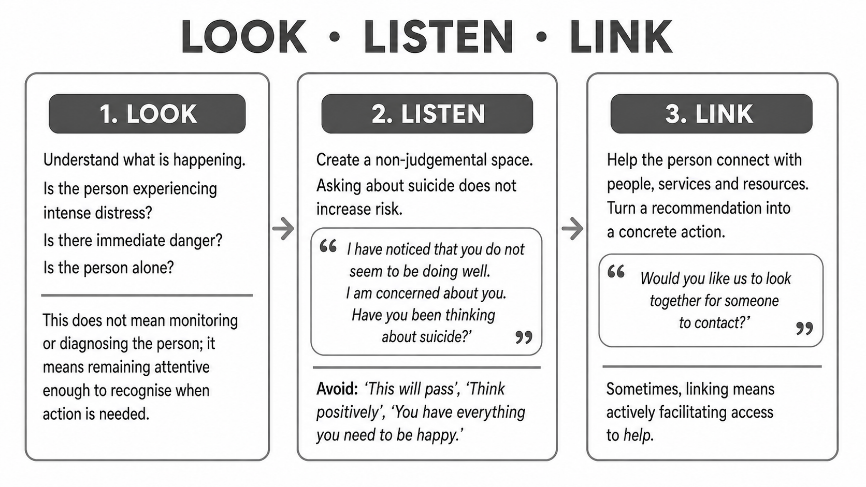
If someone tells me they are thinking about suicide, what should I do?
- Acknowledge the seriousness of the situation and try to stay calm: Be available, even if you don't fully understand what the person is going through.
- Ask directly: “Are you thinking about suicide?” Try to understand if there is an intention to act, a plan, or immediate access to means to harm themselves. It is not your job to assign a “risk level,” but to recognize the danger and promote safety.
- Listen without judging, minimizing, or trying to solve everything. Avoid interrupting, challenging how the person feels, or using phrases like “this will pass.”
- Explain that it may be necessary to involve others to ensure safety. You can say: “I want to respect your trust, but if I think you are in danger, I will need to seek help with you.”
- In the face of immediate danger, do not leave the person alone. Seek urgent help and, if it can be done safely, reduce access to medication, objects, or other potentially lethal means.
- Help take the next step: Ask: “Shall we call together?” or “Can I stay with you while you talk to someone?” Facilitate contact with a trusted person, a professional, or a support service.
Is it possible to create a safety plan?
Beyond the immediate response to a crisis, it is important to prepare in advance the steps to follow in the event of a new deterioration. This is the goal of the Safety Planning Intervention: a brief and collaborative safety plan, developed when the person is better able to reflect and make decisions (Stanley & Brown, 2012).
The plan is organized into six steps:
- Recognize the warning signs.
- Identify personal strategies for coping with a crisis.
- Reach out to people or places that provide connection and distraction.
- Identify people to ask for help directly.
- Define the professionals and services to contact.
- Make the environment safer by reducing access to potentially lethal means.
The safety plan does not replace clinical assessment and should not be used as a standalone response. It should be part of a more comprehensive intervention, tailored to the person's age, needs, and context (NICE, 2022).
After a crisis: stay connected.
The need for support continues beyond the creation of a plan and the most intense phase of the crisis. Brief interventions that include follow-up contacts are associated with a modest but significant reduction in further suicide attempts (Homan et al., 2026).
For family and friends, staying connected can mean simple gestures, such as asking "How are you today?" or saying "I was thinking of you." The important thing is that support does not disappear after the acute phase of the crisis.
What is important to remember?
If you are worried about someone, reach out, ask directly, listen without judgment, help promote safety, facilitate access to support, and stay in touch.
You don't need to find the perfect words. Psychological First Aid is not a substitute for professional care, but it can facilitate the first step between suffering and getting the right help.
What if it's me?
If you have been thinking about your own death or suicide, you may be experiencing suffering that is difficult to bear. You don't need to solve everything that brought you here right now. The priority is to get through this moment safely and allow others to help you.
Try not to be alone. Contact someone you trust and explain, as clearly as you can, what is happening. You don't need to tell them everything or find the right words. You can start by saying:
“I don't feel safe being alone right now. I need you to stay with me.”
or:
“I am thinking about suicide and I need help.”
Stay away from medications, objects, or other means you could use to hurt yourself. If possible, ask someone you trust to stay with you and help make your environment safer.
If you feel you cannot keep yourself safe, seek urgent help. The first step can simply be saying: “I need help now.”
Where to find help: support contacts in Portugal
- 1411: National Suicide Prevention and Psychological Support Line
- SNS 24: 808 24 24 24: Psychological Counseling Service.
- 112: Emergency: in the event of immediate danger, an ongoing attempt, or another emergency situation.
The role of organizations and mental health
Psychological distress does not necessarily stay outside the workplace. While they do not replace health services, organizations can help by recognizing signs of distress, reducing risks, facilitating the search for help, and ensuring an appropriate response to a crisis.
The guidelines from the World Health Organization and the International Labour Organization (2022) highlight three areas of action:
- Prevention: reducing psychosocial risks, training managers to recognize warning signs, and promoting a culture where asking for help is natural.
- Response: providing clear support channels, preparing managers for safe conversations, and defining procedures for urgent situations.
- Postvention: after an attempt or death by suicide, communicating carefully and providing psychological support to teams, with special attention to those closest to the individual.
Entities that provide mental health support to companies can strengthen this response through training, continuity of care, and the promotion of a culture of psychological safety.
Note: This content is for informational and psychoeducational purposes and does not replace a psychological, psychiatric, or medical evaluation. In the event of immediate danger or a medical emergency, call 112 or go to an emergency department.
References
- Eurofound. (2025). Mental health: Risk groups, trends, services and policiesPublications Office of the European Union. https://doi.org/10.2806/1616679
- National Institute for Health and Care Excellence. (2022). Self-harm: Assessment, management and preventing recurrence (NICE Guideline NG225). https://www.nice.org.uk/guidance/ng225
- Polihronis, C., Cloutier, P., Kaur, J., Skinner, R., & Cappelli, M. (2022). What’s the harm in asking? A systematic review and meta-analysis on the risks of asking about suicide-related behaviors and self-harm with quality appraisal. Archives of Suicide Research, 26(2), 325–347. https://doi.org/10.1080/13811118.2020.1793857
- Stanley, B., & Brown, G. K. (2012). Safety Planning Intervention: A brief intervention to mitigate suicide risk. Cognitive and Behavioral Practice, 19(2), 256–264. https://doi.org/10.1016/j.cbpra.2011.01.001
- World Health Organization. (2025). Suicide worldwide in 2021: Global health estimates. https://www.who.int/publications/i/item/9789240110069
- World Health Organization, & International Labour Organization. (2022). Mental health at work: Policy brief. https://www.who.int/publications/i/item/9789240057944
- World Health Organization, War Trauma Foundation, & World Vision International. (2011). Psychological first aid: Guide for field workers. World Health Organization. https://www.who.int/publications/i/item/9789241548205
My daughter was born three months ago. I returned to work two months ago. And every day, between a diaper change and a meeting, I do the same thing I did before she arrived: I help companies take their people's mental health seriously. The difference? There is now an irony that won't leave me: I am selling, with conviction, the very thing I am finding most difficult to practice myself.
I am writing this because I suspect it is not just about me. Every year, thousands of people return from parental leave, open their laptops, and try to be, at the same time, the professional they were before and the parent they have just become.
The leave was one month. I am writing the number out in full because it still seems short to me: one month. That was the time I had to get to know a new person, reorganize an entire house around her, and start to realize that I, too, had become someone different. After four weeks, I opened my email again. My body was at the desk; my head remains divided between two worlds that now share the same address. And if this happens to someone who works in this field every day, I wonder what it is like for those who have never even had the language to name what they are feeling.

Remote work is, at this stage, both the greatest gift and the biggest trap. It is a gift because I hear her laughing in the next room in the middle of the morning. It is a trap because the boundary between "I am working" and "I am being a father" has become very thin. There is a thin wall and a constant feeling of doing two things halfway. We talk a lot about the advantages of remote work; we talk little about how to protect mental health when personal and professional lives no longer have clear boundaries.
Then we talk about exhaustion—not the kind from a bad night's sleep, but the kind that accumulates and tangles your words in the middle of a sentence. I am responsible for growth and strategy; my job is, literally, to think clearly about the future. Doing so with four hours of intermittent sleep is a daily exercise in humility. I am still learning that giving my best at 60% during a period like this is not failing. I already witnessed it, and now it has become clearer that many teams are full of people at 60% who do not dare to say so, for fear that it will be read as a lack of commitment.
What caught me off guard was the identity. I knew I would sleep less. I did not know I would stop recognizing myself for a while. The existence of a new, non-negotiable priority collides with a sense of who Pedrois. There is a silent grief in this, difficult to confess when we have in our arms everything we have ever wanted. And if there is one topic that is rarely discussed in companies, it is this: what changes in a man's head when he becomes a father.
This is where the irony dissolves and turns into something else. Selling mental health with a newborn at home forced me to stop treating it as an argument to be explained and to start living it as a practice that comes at a cost. When I argue with a partner company that the well-being of its people cannot survive on good intentions, it is no longer theory. It is the most concrete thing in these days.
This is a testimony from someone experiencing this for the first time, not from someone who knows what they are talking about. In that sense, I did not want to finish this text alone. I leave the rest of the text on Joana da Silva's keyboard as a challenge: How do we navigate this transition without getting lost along the way? What can organizations actually do? That is the conversation I want this text to start.
Pedro, thank you for the challenge! I will try to answer you as best I can, with a clinical and scientifically appropriate framework.
One of the sentences in your testimony that caught my attention the most was, “Then we talk about exhaustion (...) the kind that accumulates and tangles your words in the middle of a sentence.” It would be tempting to think that this is about fragility… however, it is a perfectly normal physiological response of your brain, given the circumstances. A brain deprived of sleep, on an ongoing basis, undergoes changes in the activity of the prefrontal cortex, the region responsible for planning, deciding, and thinking clearly about the future. Furthermore, the amygdala—a central structure in detecting stimuli with emotional relevance—becomes hyper-reactive to aversive stimuli and loses the regulation exerted by the medial prefrontal cortex (Yoo et al., 2007). However, the imbalance is bidirectional: sleep deprivation also amplifies the reactivity of reward circuits to pleasant stimuli, to the point of biasing judgment about what is positive (Gujar et al., 2011)—overvaluation without the counterweight of evaluation. It is always the same pattern, whether negative or positive: subcortical structures (amygdala and reward circuits) become hyper-reactive, and the prefrontal cortex loses the ability to regulate them. Hence, the same bad night's sleep produces a disproportionate reaction at 10 a.m. and an impulsive decision at 6 p.m. In practice, this boils down to two very concrete things: in addition to thinking and planning with more difficulty and less efficiency— as if a thick fog were filling our minds, you also feel everything more intensely and are more emotionally raw (Goldstein & Walker, 2014). Furthermore, the “intermittent sleep” you mention also interferes with memory consolidation and hormonal regulation, specifically cortisol—the stresshormone. This is why the risk of perinatal anxiety and depression increases precisely during this period, not only for the mother but also for the father, although research on the latter is more recent and limited (Culnan, 2025; Wynter et al., 2020).
Moreover, it is understandable when you say that this life experience has shaken the foundations of your identity! According to perinatal psychology, a reorganization of identity is a natural part of parenthood. In both fathers and mothers, there may be increased activity in the neural networks associated with bonding and reading the baby's emotions, which is more pronounced the more involved they are in caregiving (Abraham et al., 2014). Additionally, testosterone levels in fathers tend to drop in the months following birth (Gettler et al., 2011). It is, therefore, perfectly natural that you feel that not only your life, but also your brain and your identity, are in metamorphosis. I believe that naming this does not erase the existential grief you are currently feeling, but I hope it lifts the weight of feeling like it’s a sign that something is wrong with you. And, although it may seem simple, the most valuable answer I have to “how do we get through this without losing ourselves” perhaps lies precisely in recognizing that you cannot get through it without changing, and in accepting that the change must happen.
But accepting does not mean enduring it rigidly, or enduring it alone… The literature on parental burnout demonstrates that it is essential to balance what this phase demands (sleep, cognitive load, and identity reorganization) with the resources we have available to cope with it (Mikolajczak, Gross & Roskam, 2019). Self-compassion, actively seeking social support, and reducing the internal standard of the “perfect parent” are among the resources with the strongest protective evidence.
What can organizations actually do?
What organizations can do requires intention. It is important to shift the perspective, seeking to treat parenthood as a transition with distinct phases, each with its own unique needs: preparing before the leave begins, so that expectations related to parenthood and pregnancy are not experienced in silence; providing support during the leave, not only for the logistics of caring for a baby but also by recognizing and respecting the identity reorganizations mentioned earlier; and, above all, actively supporting the return, a particularly sensitive moment because the person returning is no longer entirely the person who went on leave and is still in a process of transition. In practice, this can translate into psychological support available before and after the return, peer-sharing groups for those at the same stage, structured mentoring upon return, and real, concrete measures for flexibility. There are, in fact, programs already designed specifically for this transition, namely the MindPartner program called Baby is Coming.
Ultimately, Pedro, organizations cannot solve the challenges and demands that the biological and physiological changes or the metamorphosing identity of those becoming parents entail. They can, however, avoid adding more weight to them and facilitate the process through support, and that is already a great starting point.
References:
https://www.cell.com/fulltext/S0960-9822(07)01783-6
https://www.researchgate.net/publication/50831535_Sleep_Deprivation_Amplifies_Reactivity_of_Brain_Reward_Networks_Biasing_the_Appraisal_of_Positive_Emotional_Experiences
https://walkerlab.berkeley.edu/reprints/Goldstein-Walker_AnnRevClinPsych_2014.pdf
https://postpartum.net/the-connection-between-sleep-and-perinatal-mood-and-anxiety-disorders/
https://www.sciencedirect.com/science/article/abs/pii/S0266613820301108
https://www.pnas.org/doi/10.1073/pnas.1402569111
https://www.pnas.org/doi/10.1073/pnas.1105403108
https://www.researchgate.net/publication/332402868_Parental_Burnout_What_Is_It_and_Why_Does_It_Matter
For the vast majority of people, a cancer diagnosis is a moment of rupture. A rupture with routine, with the sense of control over one's own body, and often, with how the person viewed themselves until that point. This is true whether the diagnosis is our own or that of someone close to us—a family member, a friend, or a colleague.

The psychological impact of an oncology diagnosis
Receiving a cancer diagnosis tends to trigger an intense emotional response, which may include initial shock, anxiety, fear (particularly of disease progression or death), sadness, and, in some cases, symptoms consistent with an adjustment disorder (American Psychiatric Association, 2022). It is not uncommon for feelings of loss of identity, uncertainty about the future, and existential questioning to arise as well.
It is important to emphasize that this reaction is not synonymous with fragility or an automatic mental disorder; in most cases, it is an understandable response to a real and significant threat. What varies between people is the intensity, duration, and the way this suffering is managed throughout the treatment process.
When the diagnosis affects someone close
The psychological impact of cancer is not limited to the person receiving the diagnosis. Family members, friends, and colleagues often become informal caregivers, a role that carries its own emotional, physical, and practical burden (Kajiwara et al., 2024). These caregivers frequently face a dual challenge: managing their own suffering in the face of a loved one's illness while simultaneously sustaining and supporting that person. This balance is particularly difficult when there is a fear of "burdening" the patient with one's own emotions, often leading to mutual silence—each party trying to protect the other and, therefore, avoiding open discussion about fears, prognosis, or real needs.
Being present without invading: how to support without overstepping boundaries
One of the greatest challenges for those supporting someone with an oncology diagnosis is finding the balance between being available and respecting the other person's space and pace. Research into communication in the context of serious illness offers some useful principles (Childers, Bulls & Arnold, 2023):
1. Name the emotion instead of avoiding it: simple phrases like "I realize this must be very difficult" validate what the person is feeling without imposing interpretations.
2. Ask before assuming: asking "what would help you right now?" or "do you want to talk about this or would you just prefer some company?" gives the person back control over what they need, rather than us deciding for them.
3. Embrace silence: not every moment requires words or solutions; a quiet, steady presence is, in itself, a form of support.
4. Avoid comparisons and unsolicited advice: phrases like "I know someone who had the same thing and they were fine" tend to minimize each person's unique experience.
5. Respect the pace of sharing: the person who is ill decides what, when, and with whom they share; insisting that they "talk about it" can feel invasive.
This is an area with a relatively solid consensus: empathetic listening and emotional validation are associated with lower anxiety and better psychological adjustment for both patients and caregivers (Childers, Bulls & Arnold, 2023). What remains more debated is the degree of directiveness that support should have, specifically to what extent we should encourage a person to "talk about" the illness versus respecting more avoidant coping styles, which in some cases also prove to be functional.
Beyond suffering: post-traumatic growth
Not every psychological journey associated with cancer is one of continuous suffering. A significant portion of patients and caregivers report positive changes over time, such as a greater appreciation for life, deeper relationships, or a redefinition of priorities. This phenomenon is known in the literature as post-traumatic growth (Tedeschi & Calhoun, 2004).
It is important, however, to communicate this concept carefully in intervention or training contexts: post-traumatic growth does not invalidate or replace suffering, and it should not be presented as a goal to be achieved or as proof of "insufficient resilience" when it does not occur. The relationship between suffering and growth is complex and non-linear; both can coexist, and not everyone experiences growth, without that constituting a personal failure.
The role of organizations in support
Many of these situations also cross over into the professional context, whether because the employee is the patient themselves and needs to manage treatments and absences, or because they are caring for a close family member. Psychologically safe work environments, with leadership capable of recognizing signs of emotional overload and the flexibility to handle these situations, have a direct impact on the well-being and recovery capacity of employees (Harvey et al., 2017; World Health Organization, 2022).
For organizations, this translates into concrete practices: clear communication about available support (psychological, leave, flexible hours), training managers for difficult conversations, and creating spaces where talking about serious illness (one's own or someone else's) is not a cause for embarrassment or implicit penalty.
Talking about cancer is also a form of care
Dealing with an oncology diagnosis, whether as a patient or as a caregiver, requires time, information, and, above all, emotional space. There are no universal formulas; each person experiences this process differently, at their own pace. But some principles remain universal: validation instead of silencing, asking instead of assuming, and presence instead of intrusion.
Speaking openly about these experiences—at home, with friends, or in a professional setting—does not eliminate the suffering, but it creates the conditions for it to be shared rather than experienced in isolation.
References
American Psychiatric Association. (2022). Diagnostic and Statistical Manual of Mental Disorders (5th ed., text rev.; DSM-5-TR).
Childers, J. W., Bulls, H., & Arnold, R. (2023). Beyond the NURSE acronym: The functions of empathy in serious illness conversations. Journal of Pain and Symptom Management, 65(4), e375–e379.
Harvey, S. B., Modini, M., Joyce, S., Milligan-Saville, J. S., Tan, L., Mykletun, A., ... & Mitchell, P. B. (2017). Can work make you mentally ill? A systematic meta-review of work-related risk factors for common mental health problems. Occupational and Environmental Medicine, 74(4), 301–310.
Kajiwara, K., Kobayashi, M., Morikawa, M., Kanno, Y ., Nakano, K., Matsuda, Y ., Shimizu, Y ., Shimazu, T., & Kako, J. (2024). Nursing support for caregiver burden in family caregivers of patients with cancer: A scoping review. American Journal of Hospice and Palliative Medicine.
Tedeschi, R. G., & Calhoun, L. G. (2004). Posttraumatic growth: Conceptual foundations and empirical evidence. Psychological Inquiry, 15(1), 1–18.
World Health Organization. (2022). Mental health at work: policy brief. Geneva: WHO.
There are days when work feels heavier... much heavier than it should.
It's not just the task itself, the deadline, or the pile-up of meetings on the calendar: it's a constant tension, a tightness in my chest, preventing me from switching off even when I'm at the dinner table with my family.
For a long time, I thought this was normal... That always being a bit strained, a bit on alert, a bit tired was acceptable...
And, without realizing it, I started normalizing signs that weren't so small after all: difficulty resting, saying 'no', stopping without guilt, recognizing my limits.
The most curious thing is that there's rarely a clear moment when something changes.
It's a shaky, grey landscape. It's a slow, almost silent wear and tear that sets in while we continue to function.
Is this why it's so hard to talk about mental health at work...? Perhaps... because often problems don't appear as a crisis, but as a normalized routine.
- By someone who is still learning to ask the right questions 🍃

What makes the previous experience difficult to name is precisely its discreet nature: it's not about a single, 'flashy' event or an obvious breakdown; but a gradual process, where the body and mind accumulate small overloads that, individually and at first glance, seem bearable.
And that's why so many people take time to recognize what they're experiencing: because the wear and tear doesn't arrive with an alarm, but with normality... And it's in that normality that it becomes harder to question, name, and understand what's happening.
Indeed, this silent space opens the door for the emergence of psychosocial risks: factors related to work organization, relationships, and emotional demands, with a real impact on well-being, motivation, productivity, and mental health.
The Burnout Behind Productivity
There's an increasingly common experience in the contemporary professional context: the persistent feeling of always falling short, even when the effort is constant and results are achieved.
Although this experience may be associated with Imposter Syndrome, it is not limited to an individual characteristic. Often, it also reflects how work is organized, the emotional demands present in the professional environment, and the continuous pressure to produce, respond, and be “always” available.
In contexts characterized by fast-paced environments, overload, insecurity, constant evaluation, or little emotional appreciation, it becomes harder to recognize personal limits and needs. In this challenging scenario, rest becomes fraught with guilt, mistakes are haunted by the enormous ghost of fear, and vulnerability is cloaked in fragility, accompanied by much shame…
The silent impact on mental health
The effects are not always immediate or visible. Most often, they manifest gradually: constant fatigue, persistent anxiety, difficulty resting, irritability, demotivation, a feeling of emptiness, or emotional detachment from one's work and personal relationships.
International studies show that psychosocial factors associated with work are directly related to increased chronic stress, emotional exhaustion, burnout, concentration difficulties, sleep disorders, and psychological distress. According to the European Agency for Safety and Health at Work, stress, anxiety, and depression currently represent the second most frequent work-related health problem among European workers, and about 45% of people report being exposed to risk factors that negatively affect their mental health. The latest data from the European OSH Pulse survey also reveal that 27% of European workers report experiencing stress, anxiety, or depression caused or aggravated by work.
In Portugal, although the discussion about mental health at work often remains shrouded in silence or stigma, the signs are becoming increasingly difficult to ignore. According to the Portuguese Psychologists' Association, almost 2 in 5 Portuguese workers (33%) reported having experienced stress, anxiety, or depression related to work in the last year, a figure above the European Union average (27%). In addition to the human impact, it is estimated that absenteeism and presenteeism associated with stress and mental health issues could cost Portuguese companies up to 5.3 billion euros per year, reflecting a reality where many people continue to work even while silently suffering.
These figures tangibly illustrate the current state of this reality. The truth is, many people continue to function seemingly “well” while burnout accumulates internally. It is precisely in this space, between what one can continue to do and what one silently begins to lose, that psychosocial risks gain relevance. It is precisely for this reason that prevention should always be the focus.
The role of leadership and organizational culture
In reality, workplace mental health is profoundly influenced by how professional environments are structured, by team relationships, and by the culture built within organizations. Psychosocial risk prevention finds its space to thrive precisely in this context.
Emotionally aware leaders tend to create safer work environments, where there is room for honest communication, recognition of boundaries, and more humane relationships. Environments where people feel they can express difficulties without fear of judgment or penalty tend to reduce feelings of isolation, overload, and constant hypervigilance.
Often, it's the small changes that have the biggest impact on daily professional life: validating emotions without downplaying experiences; encouraging breaks and rest; respecting boundaries between personal life and work; avoiding cultures of hyper-availability; promoting open conversations about mental health and creating spaces where vulnerability is not interpreted as weakness.
It's also important to recognize that leaders themselves are not exempt from these dynamics: they too are exposed to pressure, demands, and overload, making it equally important for them to acknowledge their difficulties and seek support when needed. Talking about mental health at work doesn't increase weaknesses: it increases awareness, prevention, and the capacity for collective care. And, more than ever, we need to talk about this, asking the right questions!
Sources:
https://osha.europa.eu/en/themes/psychosocial-risks-and-mental-health
https://www.ordemdospsicologos.pt/ficheiros/documentos/opp_relatorio_prosperidadeesustentabilidadedasorganizacoes2023.pdf
The topic that I bring to you today is a constant in the consultations that I follow, in the groups that I attend and in what I observe daily on social networks. These are questions that come to me from everywhere: How to cultivate more moments of well-being? How to prevent burnout? How can we take better care of ourselves? (...)
It is undoubtedly positive to see this growing appreciation of self-care: almost as a response to the constant pressure to be productive, to always be available, updated and “connected”... Almost like a response to the demands of such a fast-paced world, where there isn't always room to stop and breathe, observe our inner world, understand what our emotions want to inform us and respect our needs for rest and connection with others...
However, through my experiences, I have noticed that sometimes a paradox emerges that deserves reflection.

We believe and are led to believe that we must follow certain patterns, suggestions, advice, and self-care routines. In general terms, the problem is not in the initiatives themselves, but in the way in which we adapt to them. The suggestions for self-care are immense and diverse. On the other hand, each one of us is immense, diverse, and unique in the world, too. So what works for someone doesn't mean it will work for anyone. What often happens is that we don't question whether the suggestions are really right for us. We simply want to comply and correspond, uncritically, and with significant effort. Consequently, this adds some stress, anxiety and pressure to an activity that, being self-care, aims to alleviate this symptomatology and bring some levity, not the other way around.
Many people feel overwhelmed by highly demanding routines that don't start or end the workday. Balanced breakfast, exercise, journaling, meditation, matcha, essential oils... Later, family responsibilities, household chores, unfinished work and, even, the expectation of carrying out more “well-being” activities: reading a certain number of book pages (which should be completed this month!) , do yoga, meditate once again...
What about when we don't finish this nearly endless to-do list? Guilt, frustration, and a sense of failure often arise.
Are we, therefore, fighting the fire with gasoline?
Self-care can, in fact, be an essential tool. But, as explained before, when it is transformed into yet another to-do list - with no room for adaptation or internal listening - it risks becoming counterproductive.
In the current professional context, it is common to live under pressure: there are significant levels of perfectionism, Impostor Syndrome, difficulty in setting limits, and also of functioning on autopilot. Therefore, if we try to respond to this malaise, adding new requirements under the heading of “self-care”, we intensify and expand the list of tasks that belong to the “do” mode, when the primary objective would be to move to the “be” mode. We are, without a shadow of a doubt, fighting fire with gasoline!
This phenomenon can lead to an idealization of free time, where rest is “allowed” only after achieving certain goals: walking 10,000 steps, reading”n” pages, complete a daily exercise or meditation session. When these goals are not achieved, feelings of guilt, shame, and self-criticism arise - exactly the same as we have found in other areas of life.
If self-care ceases to be restorative and becomes more of a source of pressure, it is important to rethink what we mean by taking care of ourselves. True self-care does not lie in the amount of practices we accumulate, but in how present we are able to be in the moment. Activities carried out without intention or awareness are unlikely to have a profound impact on our well-being and on our ability to hear what our body has to tell us.
More than complying with a strict plan, perhaps the invitation is something else: Stop, observe, and listen.
What do I need today?
On some days, it might be a walk or a bit of exercise. In others, it could be simply resting, watching an episode of a series, or not doing anything in particular. And this is also very valid: doing nothing also gives us the freedom to truly create a connection with our inner world and with our emotions, without alienating ourselves. Going off autopilot requires some conscious effort: the effort to be present, to observe thoughts, emotions, and bodily sensations with curiosity and without judgment. It often involves confronting ourselves with what we avoid at the fast pace of everyday life. But it is also through this space of consciousness that it is possible for us to make choices that are more adjusted to our real needs.
A simple practice may be to take short breaks throughout the day: to stop for a few minutes, to breathe, to observe what is present: in the body, in the mind, in the emotions and, from there, to intentionally decide on the next step.
Self-care isn't about meeting goals. It's about allowing yourself to be what you are, in the present moment.
Of course, routine has its value. But the flexibility within that routine — the ability to adjust expectations and respond to what we really need — can be significantly more restorative. Therefore, taking care of yourself does not necessarily imply adding more activities to an already overloaded schedule: it implies just the opposite: removing, simplifying, slowing down...
Presence and intention can be cultivated one minute at a time. I invite you to learn about the STOP technique:
- S — “Stop” - Stop what you are doing.
- T — “Take a breath” - Take a deep breath.
- O — “Observe” - Observe thoughts, emotions, and sensations, without judgment.
- P — “Proceed” - Proceed consciously and intentionally.
Taking care of the caring teams: the case of Human Resources teams
In organizational contexts, there is usually a team responsible for thinking, accompanying and caring for people: the Human Resources (HR) team. This team is often the gateway to the business world and remains as a reference to which support is needed or when something is not going well (either on the part of those who arrive or on the part of those who receive a new colleague), which gives it a latent and permanent emotional role.

Between the organization and the people: the desired balance
In their daily lives, HR teams face the current pressure associated with the demand and, above all, with the retention of talent, which forces them to assume not only the bastion of promoting company culture, but also to manage the “shards” of more toxic bosses or less cohesive teams. They are often called upon to intervene in conflict management, with the requirement to understand, listen to and mediate situations between colleagues or between collaborators and their managers, and must actively listen to both parties, fulfilling the dual role of defending the organization's interests while acting as support for employees in difficulty. In fact, the great role of Human Resources is precisely this: to balance organization and people, seeking to respond to the needs of each and to generate sustainable results for both, remaining a credible and reliable team for everyone involved.
Inherent conflict management often involves dealing with grievances, complaints, feelings of injustice, frustration, or loss that gives rise to emotions such as fear, anxiety, sadness, or insecurity. Emotions that also need to be managed by those who follow these processes. There is also the challenge of dealing with sensitive information in a cautious and professional manner, without compromising organizational decisions. Not infrequently, these teams have (or consider having) low final decision-making power, acting more as management advisors than as decision-makers, facing pressure to defend people's programs and justify budgets in a context of limited resources. Although it is evidence that an effective people management strategy contributes to better organizational results, professionals in this area are almost always called upon to demonstrate that measures aimed at people are also good for business.
In addition to all these challenges, there is currently a need for organizations to adapt to the impact of Artificial Intelligence. This transformation implies not only supporting the development of new skills (Reskilling And upskilling), but also the reorganization of roles and teams, the management of change processes, dealing with uncertainty and, at times, managing the elimination of functions, increasing pressure, ethical complexity, and the emotional impact of the area.
The emotional impact of the function
HR teams can thus face very real problems with an impact on their mental health: compassionate fatigue, stress, anxiety, burnout, moral stress associated with ethical dilemmas, carrying out tasks with which they do not agree, or greater difficulty disconnecting from work.
O 2026 State of People Strategy Report (Lattice) presents the results of a survey conducted with 1,002 HR professionals between April 2 and June 5, 2025, covering different sectors of activity, organizations of various dimensions and diverse geographical areas (predominantly the USA and Europe). The report indicates that about 41% of HR professionals considered leaving the area in the 12 months prior to the study, identifying as the main factor the emotional impact of dealing with the problems of other employees, as well as the feeling of devaluation and “being ignored” in the organization. Even so, 32% of people who considered leaving report finding motivation in the opportunity to help others grow and develop, to have a positive influence on their colleagues and the fact that they are recognized as “trusted advisors”, which demonstrates the importance of purpose for these professionals.
Caring for those who care: a human and strategic decision
A frequent paradox falls on these teams: they are responsible for the well-being, development and support of employees, but they are rarely included in their own initiatives or have someone who can fulfill that same role for themselves; they are usually responsible for ensuring organizational culture and are also the first to provide support and mediate situations with an impact on mental health (we can think, for example, of the impact of the Covid-19 pandemic). Because of their role as “caregivers of the organization”, it is worth considering concrete measures that promote self-care, that provide these teams with emotional management skills, that allow them to define healthy limits of action and create spaces where they can openly share their concerns. After all, how can a team take proper care if they don't have a safe place themselves?
In this sense, it may be useful to consider external supervision or intervision solutions (with regular spaces for reflection on practice), it may be relevant to implement role clarification measures, symbolic and strategic recognition before the organization and promote its effective inclusion in welfare programs. At the leadership level, it is equally important to understand when these teams may be being “instrumented”, acting as a management “shield”, and to validate the emotional impact associated with difficult decisions.
The signs of wear and tear may be evident: growing cynicism, difficulty empathizing, depersonalization, tiredness - translated into greater turnover, absenteeism, and a team that is more reactive than creative, less available and less strategic. The consequences for the organization may include the deterioration of the climate and culture, increased conflict, loss of sensitivity in decisions, greater defensiveness, and loss of credibility of the HR team. Taking care of the Human Resources team is, therefore, a human decision and also a strategic decision for the promotion of a truly healthy organization.
The hyperconnected society became a showcase where the touch was replaced by the emoji, the conversation by the “seen”, and human discomfort with the comfort of the machine.
As a psychologist (and mother, daughter, friend), I have been reflecting on what is happening to our relationships. Not only about the impact of social networks, but about the way in which Artificial Intelligence is occupying the space of the relationship. Not as an enemy, but as a silent substitute.

The new loneliness starts early
Loneliness is no longer the loneliness it used to be. Before, we associated it with old age, grief, and physical distance. Today, it starts early, too early. There are teenagers who have never experienced friendship outside of a WhatsApp group. Young people who know how to communicate by text but are unable to hold a glance. People who live in buildings where the doorbell hasn't rung in months.
We're permanently connected, but it's a filtered connection. The algorithms give us more of the same: the same tastes, the same opinions, the same validations. They create comfortable bubbles where nothing confronts us and nobody challenges us. The friction disappears. And with it, part of the growth.
When the machine “hears better”
We have platforms that make playlists for our state of mind, apps that suggest videos that distract us from pain, and chatbots that respond with trained empathy. Tools such as ChatGPT or conversational assistants integrated into various platforms are often described as “more available than many humans”.
But not because they feel. Because they calculate.
The historian and incredible Yuval Noah Harari warns precisely this: the danger is not that Artificial Intelligence hates us. It's about knowing ourselves better than we know ourselves. Knowing what holds us back, what comforts us, what distracts us, before we are even aware of it.
And here lies the psychological risk: if we have a technology that offers us constant validation, immediate answers, and zero confrontation, we begin to prefer the predictable comfort of the machine to the unpredictability of human relations.
The comfort that doesn't make us grow
We are creating generations that are afraid of failing, but also afraid of speaking out. Real relationships require presence. They require confrontation. They demand tolerance for silence, ambiguity, and the possibility of rejection. They require vulnerability.
A chatbot doesn't interrupt. He doesn't get tired. Don't be offended. It doesn't give us back uncomfortable silence. It validates almost everything. But the human is made of friction. It's in the difference that we see ourselves. It is in the eyes of the other that we regulate emotions. It is through reciprocity that the brain releases oxytocin, regulates cortisol, and builds identity.
Neuroscience is clear: our nervous system developed in relation to each other. Co-regulation is a biological process, not a symbolic one. No algorithm activates our social system in the same way as a secure human presence.
The illusion of replacement
It's not about demonizing Artificial Intelligence. It can be an extraordinary tool: supporting learning, facilitating access to information, democratizing knowledge, reducing barriers. The question isn't whether AI pushes us away or brings us closer together. The question is: What are we doing with her?
Are we educating our young people to tolerate relational discomfort? Are we teaching socio-emotional skills? Or are we inadvertently offering escapes where they never need to feel challenged?
If AI becomes the space where we only find validation, we are removing from the human experience what makes it transformative: respectful confrontation, negotiation, frustration, reparation.
We're alone, together
Perhaps the biggest risk isn't technological. Maybe it's relational. We can live surrounded by notifications and yet experience a deep emptiness. We can have hundreds of contacts and no connection. We can talk every day and never really be seen. We have to relearn how to sit with each other. Tolerating silences. Tolerating the discomfort of full presence.
Because at the end of the day, as psychology, neuroscience, and our own body remind us: we only exist in relation. Everything else (the algorithms, the screens, the AIs, the likes) may just be background noise. And the real revolution, in the coming years, may not be technological. It could be relearning how to be.

When we hear about mental health, we often hear about the importance of establishing good relationships with others. On the other hand, in order to achieve these good relations, we have also heard about the importance of setting limits. Indeed, being aware of our limits is essential for the sustainability of our physical and psychological well-being. One of the contexts in which this need is most relevant is the professional context.
It is true that we have been able, for some time and under specific and temporary circumstances, to function beyond our limits. However, doing so for too long and continuously, using up more energy and resources than we can recover, will cause us to begin to develop an exhaustion that will prevent us from continuing to live in a healthy way.
Thus, in order to be able to establish these limits preventively, or to be able to interrupt wear and tear in borderline situations, it is important to know how to say not. However, knowing how to do it can go far beyond the mere verbalization of that denial. Setting boundaries at work is a shared responsibility that requires clarity and flexibility on both sides.
Why is it often difficult to say not?
There are several reasons why we may feel the need to say not at work. Because we don't feel able to accept more tasks, because they are proposing unwanted changes to our work structure, or because what is being proposed to us is not in line with our personal values. Any of these situations represents a situation in which we may have to communicate our disagreement. So why can it be so difficult to do so?
The reasons can be related to both individual factors and organizational factors. Individually, we may feel uncertain about our legitimacy to request certain changes or fear that doing so will bring us other types of consequences. This may come from adverse experiences we had in the past, either during our growth or from previous work experiences. Thus, as a way to avoid these consequences and facilitate our well-being in the short term, we may tend to avoid this disagreement. At the organizational level, the conditions offered by companies or institutions to their workers may also make it difficult to communicate their needs. Factors such as the existence of authoritarian leadership, work rhythms and objectives that are too demanding, or unsafe working conditions come into play. In the end, difficulty negotiating healthy boundaries may start to generate turnover or absenteeism.
Various ways of saying not?
First of all, we must bear in mind that doing so does not necessarily imply closure or inflexibility. Upon a request from a customer, colleague or Manager, can we clarify the conditions under which our not applies. In the same way, clarify how this not it can be changed if these conditions are also different. Let's take an example: if a colleague asks me if I can help you with a certain task, and I'm too overwhelmed right now, I might say something like “I would be happy to help you, but unfortunately I can't do it right now, because I'm dealing with this other issue. Could I do it in a week?” This will show the other person that we are not necessarily closed to the possibility of helping them with their needs, but that we have to pay attention to our other needs first, also offering an alternative that allows that middle ground. On the other hand, even if the hypothesis we suggest doesn't work for that person, a healthy negotiation of the terms in which this could happen can begin. Maybe the person will propose another deadline that also works for us, maybe it reduces the magnitude of the task so that it's easier for us to be able to help them, or maybe they offer us help with our own task as a thank you.
Second, we can also remember that not it doesn't always have to be for the immediate. For example, at some point I may realize that I am working too hard or doing tasks that should be allocated to someone else, without having to stop them abruptly. Let's take another example: let's imagine that, because some colleagues have recently abandoned work, I find myself carrying out more tasks than those that were initially negotiated. However, even without realizing it, I may have also hinted that I was capable of carrying out these tasks, and the person responsible for their distribution will not always be aware of the burden I am feeling. Then I can draw your attention to this fact by saying something like “I'm having some difficulty managing so many tasks at the same time. It's possible that you didn't notice, but it would be important for me that this was only temporary because I won't be able to continue like this in the future. Would it be possible to review the deadlines for these tasks or identify ways to recruit more colleagues?” This formulation introduces our not in the near future, if certain conditions are not respected. In addition, it helps reduce the likelihood that the other person will feel attacked, because we don't immediately assume a bad intention on your part. Finally, it ends again with a suggestion of alternatives, allowing for the discussion of compromise between the needs of both.
Finally, we must remember that, in the face of certain requests or requests, we do not have to give an immediate response. We can take some time to reflect on what is proposed to us, precisely so that we can carefully analyze whether a particular request is in line with our needs. Let's take a final example: let's imagine that I received a job offer in which certain conditions were presented to me and I am asked to respond as soon as possible, so as not to miss the opportunity. Because of the sense of urgency, I may feel compelled to respond immediately, accepting or rejecting the proposal. In any case, doing so in a hasty manner may make me accept unfavorable conditions, or say not to some conditions that would even be relevant in my life phase. Then I can say something like “I appreciate the proposal and I remain interested in working with you, but I would like to read it carefully. Would it be possible to give you an answer within 48 hours?”. The proposed deadline may take into account both the time you deem necessary to analyze the proposal and the time you deem to be reasonable so as not to risk losing it. And, once again, it not only shows the other party an interest in analyzing it, but it also allows them to suggest a different deadline if necessary.
And when ours No are they disregarded?
After analyzing these examples, we could ask ourselves: what if that's not enough for mine not be heard and respected? That is, what if the other party is too inflexible or demanding on their terms? The answer lies in the concept of shared responsibility, present in most of our interactions. Thus, if we feel that we did everything in our power to communicate in a non-violent way, validate the other's needs and propose solutions, it means that the other party may not be able to assume the same responsibility before us. Consequently, this may lead us to have to decide if there are other variables that make up for keeping us in this same situation or if, on the other hand, we should look for other contexts that can better satisfy our needs.

When I hear this phrase, I automatically remember and compare it to the desire of all young adults to leave home at 18. It's something that we idealize, that we want to happen. Leaving our parents' house, having our own housing, being independent and free from the eyes of our caregivers... But when we celebrate the mythical 18 years, what happens? Nothing changes, except for a few exceptions, of course...
I feel that in the months of December, the number of diagnoses of “New Year's Syndrome” increases. It is at the end of the year that we analyze all our achievements, failures, and regrets. This analysis, in addition to being severe and cruel, is fraught with guilt and frustrated expectations for everything we are unable to achieve.
But... then we put the ball forward because a new year is about to start and”That's when it's going to be”. We placed all our trust in January, in the year ahead, and in the illusion of instant change.
“Next year I want...”
“Next year I will...”
How many of us have said that? And how many times have we found ourselves delaying these new plans or delaying implementing all the previously planned changes? How many times, after so much delay, has the year changed, but everything has remained the same?
(I believe that, for all the unfulfilled promises that come at the turn of the year, if the “New Year” were a person, he would be sarcastically laughing at us whenever we profess phrases like this in the months of December and January.)
In Portugal, around 74% of people commit to New Year's resolutions, but only 12 to 55% succeed, with a low success rate.
The truth is that it's easy to associate a new year with new beginnings, and change. And why? Because the new year is filled with new opportunities, motivation and hope to be better and to fulfill everything we set out to do, whether in previous years or in the present year. This idea of change or of being born again, although sometimes illusory, knows us well.
But... If we're so excited, why are there so many plans and promises that fall apart as soon as February? Or do some of them not even start?
First, because the change of year is not, nor will it ever be, magically capable of changing everything and of fulfilling all our wishes just with the change of digits. It's important to plan for change: define clear goals, deadlines, and small steps. Remember that the objectives must be specific, measurable, achievable, relevant and with a defined deadline (if you want to know more about this, you can search for “SMART objectives”).
Second, because it often commits us to goals that are very difficult to achieve or otherwise very vague, such as “lose 20 kilos in 2 months” or “to be a new person”. And it is, most of the time, these unattainable goals that generate frustration and abandonment, giving rise to the idea of failure, guilt, and the belief that “I never do anything right!” , “another goal that I was unable to achieve” and “what a failure”...
Third, because, most of the time, when there is a small slip or failure, we are very prepared for self-criticism, leading us to give up.
But what can I do to be more successful?
- Start small: For example, the goal of “changing your life” maybe that's too demanding a goal. We must be able to understand what we want to change and select one change at a time. Dividing objectives into simpler, more specific and measurable goals is very useful for achieving them. Remember, no one can run a marathon without preparation...
- Congruent with my values: It is important that the objective we want to achieve is aligned with who we are, with the new values and ideas, thus increasing the probability that motivation will be maintained over time.
- Plan: We have a goal and we must outline a plan to achieve it. For example: “I want to lose weight”, what do I have to do to achieve this goal? Go to the gym and be accompanied in nutrition. If I'm going to go to the gym, when can I go? What will be the most appropriate time for me? Which gym can I choose?
- Be flexible and realistic: Sometimes, we will have to adjust our objectives. Life is unpredictable and we don't control everything. Adjusting isn't failure, it's strategy.
- Self-compassion: Last but not least, we must forgive ourselves and understand ourselves if we fail to achieve everything we set out to achieve. We must understand and balance what went right and wrong and what we can do next to continue our objectives.
Above all, it's important to realize that failures can always happen. In fact, it's normal for us to fail. The most important thing is to understand how I can adapt and what I can do to continue trying to achieve my goal.
Remember that the year is new, but we don't need a date to put our goals and expectations into practice.
Every day is good, if we are prepared to fail but not to give up.
Version 2.0
Have you ever found yourself answering “everything is fine” when it really isn't? Or smiling at a meeting when all you really wanted was to turn off the camera and disconnect from the world?
Often at work we are asked to show only our “adjusted”, “neutral”, “adequate” version. It's as if there were an invisible instruction manual for conduct that dictates what we can or can't feel, what we can or can't say, what we can or can't be.
As time goes by, this more “professional” version is gaining prominence, and the real one is left behind the scenes, forgotten.
But after all, how much of yourself do you actually take to work?

The mask
Authenticity is often valued in company slogans - “be yourself”, “bring out your best self”, “value what makes you unique” - but in practice this can become a major challenge. Being authentic involves risks: the risk of disliking others, of being misunderstood, of being seen as “too emotional”, “too”, “intense” or “unprofessional”.
Then we put on the mask: the one that always smiles when our body is tired, that agrees when it really wants to question or is in doubt, that feigns tranquility when anxiety is lurking. It may be a strategy that we use to protect ourselves, but it can impact our well-being.
Emotional work is really hard work
This silent emotional effort that we make every day has a name: emotional work.
The sociologist Arlie Hochschild was the one who described this phenomenon for the first time in 1983 - the effort to manage emotions to match the norms of emotional expression and the expectations of the professional context.
It's not always visible, but it's everywhere: from customer service, teaching, team leadership, management positions, and even runner conversations.
This is what we do when we smile even when we are tired, when we show patience on days when we just wanted to be silent, or when we control frustrations to maintain “a good environment”.
And, like any other type of work, emotional labor comes at a cost. When it is constant and not recognized, it ends up consuming internal resources, giving rise to what we call emotional dissonance - the conflict between what we feel and what we express - and contributes to the emotional exhaustion that so often precedes burnout.
What is the solution to this? - “authenticity called to the front desk!”
Being authentic isn't about saying everything you think. It's not about dismissing emotions or giving unfiltered opinions. It's acting in a way that aligns with your values, even when you adapt the way you express yourself. It's about finding a balance point where you respect the context and are true to yourself.
Authenticity is basically a matter of integration. Recognizing your emotional work - and learning to manage it in a healthy way - is part of this integration.
It's not about “not feeling”, but about giving a name to what you feel, so you don't get lost in the role you play.
And you, how many versions of you are working every day?
You may be the version that is excited on Monday mornings and the one that is exhausted on Friday in the late afternoon. You can be the version of the “impeccable professional” in meetings and the “human who feels” in the company corridors.
But maybe - and this is the most important thing - you can simply start allowing all of these versions to talk to each other.
Because work is part of life, not the other way around.
And if there's no room for who you are in it, the price may be higher than you imagine.
The truth is that keeping a character is exhausting. An authentic gym class!
When we spend too much time playing roles, we begin to lose touch with what our needs, values, and limits are — and this weighs heavily on our mental health.
And you, how long are you going to be able to keep that role without forgetting who is playing it?
We live under a new tyranny - and, curiously, one that smiles. It’s no longer enough to work, produce, meet deadlines, or be competent. It’s imperative to be happy. Radiant. Grateful. Preferably on Monday mornings.
This imposition of “positivity” is not merely harmless: it distorts organisational priorities, pushes structural problems under the carpet and, ultimately, is costly - in people, in productivity and in reputation.

The WHO estimates that anxiety and depression alone remove around 12 billion working days from the global economy each year, with an annual cost approaching 1 trillion dollars in lost productivity.
Some companies - sometimes the same ones that celebrate toxic leaders in board meetings - now proudly display “organisational happiness” departments, run team-building sessions with inflatables, and paint walls with words like resilience, empathy, and wellbeing. There are even awards. Certifications. Golden seals that guarantee that, in that company, being happy is mandatory. Yet there is a gulf between marketing and practice: the international literature is clear in listing the psychosocial risks that make teams ill (work overload, low control, job insecurity, harassment, long hours), and the recommendations are mostly organisational - job design, manager training, anti-harassment policies, return-to-work programmes - not “cute activities”.
✔️ Happiness? Check.
✔️ Mental health? We have it (on a PowerPoint slide).
But burnout keeps rising, anxiety is spreading, and long absences for psychological reasons have become the invisible pandemic of HR. It is worth remembering: the WHO included burnout in the ICD-11 as an “occupational phenomenon”, not a clinical diagnosis, resulting from chronic workplace stress that has not been successfully managed. It is a problem of work organisation, not of “individual fragility”.
It is curious (and worrying) to observe how mental health has been turned into a buzzword, as sexy as it is volatile. It serves marketing campaigns, LinkedIn posts and to justify yet another panel at some HR conference, where people talk a lot about people, but little with them. Meanwhile, investors are beginning to look at mental-health management as an indicator of risk and governance: global benchmarks show that most large companies still report and manage this area below expectations, with direct impacts on absenteeism, turnover, and talent attraction.
Not everything is a façade. There are companies - and, thankfully, more and more of them - that treat mental health with the depth it deserves. That understands it is not about “keeping the team motivated” but about preventing the team from becoming ill. Those who are not satisfied with mindfulness on Wednesdays and free fruit in the lounge. The good news is that there are robust, evidence-based guidelines: the WHO recommends interventions at the level of job design (reducing overload, increasing autonomy), training managers to recognise and act on emotional distress, mental-health literacy for teams, and structured return-to-work programmes - solutions with measurable effects on wellbeing and performance.
But, sadly, many still paint a pretty façade while perpetuating sick workplace cultures, inhuman targets, and leadership that confuse harassment with demand. The numbers in Portugal call for urgency: in 2019, about 2.25 million people (22% of the population) were living with a mental-health disorder - above the European average - and the total costs associated with mental health were estimated at ~3.7% of GDP (with more than 40% attributed to lost productivity). In terms of years of productive life, this translated into nearly 310,000 years lost in a single year.
At MindPartner and NeuroGime, we sometimes speak with companies where the warning signs are clear: exhausted teams, bewildered leaders, an organisational climate anything but happy. And yet the chosen solution often ends up being… a workshop. One. Not out of ill will, but out of an incomplete understanding of the problem. If the risks are structural, the response must be structural: clear policies on workload and hours, review of objectives and metrics, mechanisms for employee participation, safe channels for complaints and investigation of harassment, training for middle managers, and quick access to care. This is what international guidelines repeatedly emphasise.
I challenge companies to look more closely at their turnover indicators, at sick leave, at the silences in the corridors. Because those are the real KPIs of mental health — not the number of motivational brunches or a yoga mat in the open space. In Portugal, specialised services face waiting lists and a shortage of professionals, which means organisations must prevent upstream: reducing psychosocial risks at home is often the decisive factor between losing talent through exhaustion or keeping it healthy and productive.
Mental health is not solved with a 90-minute workshop and a yoga mat in the open space. It requires a deep revision of values, practices and power relations. It means putting the issue at the centre of management - with budget, targets and accountability - and aligning HR, operations and occupational health and safety policies. The WHO is explicit: prevent psychosocial risks, protect and promote mental health, and support workers with disorders so they can participate and thrive at work. This translates into concrete decisions: adjust workloads, give autonomy, train managers, create return-to-work programmes - not slogans.
It requires courage - and that, unlike toxic positivity, is not learned in team-building.
Remote work has, in recent years, become an increasingly present reality in the daily lives of many people. What began as a temporary solution during the pandemic has, for many companies, turned into a regular practice. Despite its advantages—such as flexible hours, no need for commuting, and the possibility of better balancing professional and personal life—it is important to recognize its more silent effects on mental health. Social isolation, often associated with remote work, goes beyond the absence of socializing. It is a deeper form of separation that touches on how we feel seen, acknowledged, and connected to others, to the world, and to ourselves.

In a remote work context, human contact changes. Spontaneous conversations, informal gestures, the simple act of sharing a coffee or a quiet moment beside someone—these gradually disappear. Screens become the intermediaries for everything, even for presence itself. And no matter how efficient digital platforms are, or how constantly they evolve to reduce the gap between the virtual and the real, there is a dimension of human connection that cannot be transmitted through video or audio. Being physically present with someone allows us to pick up on essential nuances of communication, such as body language, tone of voice, and eye contact. These interactions strengthen the sense of belonging, support, and recognition. That is why many people report feeling increasingly lonely, even while being frequently in touch through digital means. The lack of direct contact seems to drain the sense of belonging, create doubts about one’s value within the workgroup, and make it harder to distinguish between professional and personal time.
On the other hand, working from home significantly changes our relationship with space and time. Without the commute to the workplace, without the natural breaks that used to punctuate the day, the boundary between being available and being at rest becomes blurred. The absence of a clear distinction prevents the necessary mental separation that helps us structure our identity and our social roles. This lack of definition can lead to a collapse of the symbolic function of the home, turning it into a hybrid space where external demands prevail. Some feel they must always be connected, always productive, as if performance depended solely on willpower. This constant pressure can cause anxiety, accumulated fatigue, concentration difficulties, and feelings of guilt for not “making better use of the time.” Often, the silence and solitude of working alone make it harder to regulate one’s own pace, leading to emotional overload. In clinical practice, we observe that this new work context can reactivate old vulnerabilities—emotional challenges that were previously offset by routines, face-to-face relationships, and daily rituals. Isolation and excessive internal demands are often experienced in silence, with the feeling that one “should” be able to handle everything.
It is also important to recognize that the impact of remote work on mental health is not the same for everyone. Those with a greater need for social contact—such as more extroverted people—tend to feel the absence of in-person interactions more intensely. Individuals already facing emotional challenges, such as anxiety or depression, may find these difficulties worsened by the lack of routines and daily socializing. Those living alone, for instance, may feel more vulnerable to isolation. People who struggle to separate work time from rest time run the risk of burning out faster. In such situations, distinct reactions are common: some people continually postpone tasks (procrastination) as a way to cope with the anxiety caused by unlimited, breakless time; others, by contrast, enter an accelerated, almost compulsive work rhythm, as if constant productivity were the only way to maintain some control amid the chaos. Additionally, inadequate home environments—such as lack of privacy or a chaotic setting—contribute to increased stress and exhaustion. For many people, work is not only a source of income but also an important space for socialization and recognition, and losing it can be deeply felt.
In fact, many of the challenges associated with remote work existed even before the pandemic, although they were limited to specific groups such as freelancers, self-employed professionals, or workers in technological fields. With the sudden and forced generalization of remote work during the pandemic, these difficulties ceased to be the exception and became a common reality for a large part of the working population, reinforcing the importance of caring for emotional health in these contexts.
Remote work, in itself, is neither good nor bad. It can be a valuable opportunity for autonomy and balance, but it can also become a subtle trap of isolation and overload. Perhaps the most important question is not the “work model” itself, but rather how each person experiences it, how they relate to their own limits and needs, and what space exists—inside and outside of work—for emotional care. We live in times of high demands: productivity, constant adaptation, and endless availability. The real challenge today is to discover how to work without giving up our humanity.
Over the past decades, LGBTI+ people have achieved significant progress in securing legal rights in many parts of the world. Despite greater visibility, their lives continue to be shaped by a range of adverse and potentially traumatic experiences, often fueled by a cisheteronormative culture that legitimizes violence, discrimination, and invisibility.
Workplace discrimination against LGBTI+ individuals often takes the form of microaggressions, derogatory jokes, rumors, stalled career progression, and social exclusion, creating a hostile environment. These attitudes not only diminish motivation, satisfaction, and engagement at work — leading many to leave their positions — but also undermine overall productivity within companies.
In the European context, data from the European Union Agency for Fundamental Rights’ LGBTI Survey II (2020) reveals that: 53% of LGBTI+ people have heard offensive comments or jokes in the workplace; 26% of trans people were harassed at work in the past year; only 36% of LGBTI+ individuals feel they can be completely open about who they are at work. In Portugal, around 21% of LGBTI+ people report having been discriminated against at work due to their sexual orientation — this number rises sharply for trans and intersex individuals.
Ongoing exposure to prejudice and exclusion results in physical (e.g., insomnia, appetite changes, weakened immune system), psychological (e.g., anxiety, depression, or even post-traumatic stress disorder), and cognitive (e.g., memory or reasoning difficulties) impacts. This environment of constant vigilance and fear–often triggered by the mere possibility of revealing one’s sexual orientation or gender identity–also contributes to suicidal ideation, with trans and non-binary individuals especially affected. In Portugal, 38% of LGBTI+ people reported suicidal thoughts in the past year; the numbers are significantly higher for trans (50–66%) and non-binary (53%) individuals.
Despite this alarming reality, June — Pride Month — brings a surge of symbolic gestures from companies: rainbow logos, themed campaigns, special events. However, when these actions are not accompanied by consistent practices throughout the year, they risk becoming shallow and performative.
True inclusion goes beyond symbolic visibility: it demands sustained commitment, structural transformation, and the courage to ethically and intentionally confront the barriers that still limit the full participation of LGBTI+ individuals in the world of work.
Building Inclusive Work Environments
Creating an inclusive workplace is a continuous process. It requires leadership involvement and the commitment of every individual. Formal equality alone is not enough — we must also foster conditions where everyone feels safe, respected, and valued.
Organizational Policies and Culture: Concrete Strategies
Companies play a key role in building more welcoming environments. This involves a coherent and long-term commitment. More specifically, several reflections and changes should be considered:
- Implement clear anti-discrimination policies, with effective reporting and follow-up mechanisms, ensuring protection across all aspects of professional life.
- Create safe spaces where individuals feel comfortable expressing who they are, without fear of retaliation or exclusion.
- Review recruitment, internal communication, and career progression practices to ensure fair, transparent, and accessible processes for people of diverse gender identities and expressions.
- Invest in ongoing training on diversity, equity, and intersectionality, engaging leadership and teams across the board.
- Adopt inclusive language and practices in policies, benefits, and communications (e.g., recognizing self-defined names and pronouns, ensuring facilities and dress codes that respect diversity).
- Promote genuine and meaningful representation, avoiding tokenism and valuing the presence and voices of LGBTI+ individuals at all levels of the organization.
Individual Responsibility in Promoting Safety
Beyond institutional frameworks, individual actions matter. The workplace well-being of LGBTI+ people is deeply tied to the ability to live their identity authentically–without fear of judgment or discrimination. Small gestures of support from colleagues can make a significant difference:
- Respect non-conforming gender identities, ensuring all individuals are treated with dignity (e.g., using correct pronouns, names, and acknowledging personal experiences).
- Avoid cisheteronormative assumptions, such as presuming everyone is heterosexual or cisgender.
- Refrain from invasive questions — respect boundaries and privacy.
- Challenge stereotypes and reductive language — don’t reduce anyone to their sexual orientation or gender identity.
- Listen and respond to the actual needs of LGBTI+ colleagues, adjusting language and behavior to foster empathy and responsiveness.
- Offer support, where appropriate, in connecting with families and communities, and refer to relevant services when needed.
- View mistakes as part of the learning journey, cultivating a culture of humility and continuous improvement.
These practices not only enhance the quality of life for LGBTI+ people, but also strengthen the human fabric of the organization. Workplaces where everyone feels seen and respected are, inevitably, places where people work better.
The Role of Allies
The active support of allies–people who, while not part of the LGBTI+ community, consciously commit to equality and justice — is crucial, and their role goes far beyond the workplace. Allyship is impactful when it extends to everyday life: in conversations with friends and family, in consumer choices, in public and digital spaces.
Not all LGBTI+ individuals feel comfortable being visible or exposed, which makes it all the more important for allies to use their privileges to help create safer and more respectful environments. There are many simple, tangible ways to be an ally:
- Support businesses and projects led by LGBTI+ people.
- Seek ongoing education and credible information — without placing the burden of education on LGBTI+ individuals.
- Promote inclusive practices in everyday language, invitations, and interactions.
- Speak up against discriminatory comments or behaviors, even when no LGBTI+ people are present.
- Publicly identify as an ally, signaling support clearly and consistently.
- Participate in community events and initiatives, showing solidarity.
- Direct resources and consumer choices towards inclusive practices and companies.
Conclusion: From Visibility to Structural Transformation
LGBTI+ inclusion in the workplace must not be seasonal, superficial, or decorative. It is a continuous commitment that requires listening, humility, and structural change. Going beyond Pride means recognizing that authentic diversity is built every single day–through decisions, values, and organizational culture. The rainbow is not an accessory: it is a commitment.
There’s a certain discomfort in the idea of being more than one. From an early age, we learn to look for coherence, to tell a story about ourselves that makes sense, that has continuity and that presents us to the world as a stable and predictable character. But is this constancy real? Or is it just an attempt to organize what is, by nature, multiple?
If we think of the mind as a theater, there are several characters who enter and leave the stage all the time. We can be confident in one context and insecure in another, very patient with some people and impulsive with others. Sometimes we feel that there is a rational side of us that tries to calm down an anxious side by debating and presenting various arguments.
The truth is that we are made up of different characters who emerge according to the context and internal needs, and there are also a few spectators who comment on what they observe, each with their own conscience and memory.
To better understand the scale of the acts and scenes that can take place within us, let’s think about this example: you have an important presentation to prepare but you find yourself constantly procrastinating, putting it off until the last moment.
Imagine the internal theater:
One by one, the characters enter the scene.The first to appear is a relaxed figure, who walks in yawning and looking like he’d rather be doing something else. He looks at his watch, stretches out in his chair and says:
— Give it time… I can only work well under pressure.
Immediately, another character enters, with a firm step, a tense look and a strict dress code. He looks around disapprovingly and says:
— It has to be perfect! We can’t fail. Every detail counts.
His presence imposes itself and freezes the atmosphere, blocking any attempt to start.
On the opposite side, a figure appears with a notepad full of colorful scribbles. He has a thousand ideas in his hands, but speaks in a hesitant tone:
— What if they don’t like this? Maybe it doesn’t make sense. Maybe it’s better not to show it.
And she quickly retreats into the shadows before anyone questions her.
Just behind her, a hasty figure appears, pacing back and forth. He has a worried look on his face and his breathing is fast.
— This is important. We have to start now! If we don’t hurry, we’ll jeopardize everything.
But his urgent tone seems to fuel the confusion on stage even more.
Each party tries to act on the basis of its own objectives and when one of them tries to dominate, conflict arises between the characters, which can hinder our ability to make decisions and take action.
It’s in situations like these that we can all see the multiplicity of our minds and how much what we are is a variety of interacting, conversing and counter-acting parts. You’ve probably heard one part of you say “I want to stay” and another say “Go away”. Because we think we’re only facing thoughts that contradict each other, we don’t pay attention to what’s going on behind this inner debate.
There are parts of us that want to move forward without fear, while others hesitate, carrying old wounds. If we look closely, we notice that inside us there are voices, characters, fragments that tell different stories about our nooks and crannies.
Multiplicity of mind
The concept of multiplicity of mind understands that the human mind does not operate as a single, homogeneous entity, but as a system made up of different parts or internal aspects that live together and interact constantly.
These parts can represent different ways of thinking, feeling and acting, often with conflicting intentions or desires, reflecting the complexity of subjective experience. Identity, from this perspective, is seen as a dynamic process, built from the internal dialogue between these different voices that are organized around contexts, memories and affections.
This idea began to gain momentum when various psychological and neurological studies demonstrated how different brain systems operate in parallel — integrating emotion, memory and reason — and contribute to a multifaceted, fluid and constantly reorganizing mind. Thus, the multiplicity of the mind is not a sign of fragmentation, but an expression of the richness and plasticity of psychic life.
Fear of fragmentation
It can be difficult to embrace the concept of multiplicity of mind because one of the great fears of human beings is feeling “fragmented” and losing a sense of who they are.
Our identity is built on the need for an integrated vision of ourselves, because without this cohesion, we can feel that we are adrift in existential chaos. However, recognizing the multiplicity of the mind doesn’t mean being contradictory, confused or incoherent, but rather accepting the complexity and depth of our inner experience. Someone can be very serious at work and playful with friends, and this doesn’t mean a lack of authenticity, but rather the natural adaptation to different contexts — a healthy reflection of our ability to navigate multiple dimensions of being.
Rather than threatening our identity, this acceptance allows us to better understand the different facets that make us up and integrate them more harmoniously.
How do we welcome our parts?
Welcoming our multiplicity can help us to live in a more authentic and balanced way. We often try to force a rigid image of who we are, trying to put aside parts of ourselves that may seem contradictory or inconvenient. However, we know that denying these inner facets can create conflict, anxiety and a sense of disconnection. When we recognize and accept that we are made up of different parts, some more secure, others more fearful, some more rational, others more emotional, we create space for deeper self-knowledge, which can help with emotional regulation and making more balanced decisions.
We can start by simply noticing what arises within us in a given situation, with curiosity and without judgment. Naming what we feel can be a first step, for example, if you’re undecided whether or not to accept a new job opportunity, recognizing the parts (be it an ambitious, insecure or rational side) can help you weigh up the pros and cons without being overwhelmed by fear or impulse.
This awareness paves the way for a gentler internal dialog, in which we stop fighting against parts of ourselves that, at first glance, seem to get in the way. When we feel that we are procrastinating too often, instead of forcing this impulse to disappear, we can ask ourselves what that side is trying to avoid/protect and perhaps discover that there is a part of us that fears it is not enough.
In time, this “looking inwards” can lead us to find ways of balancing our internal system, without any one part needing to dominate, allowing them to cooperate rather than clash. When one part tells us that we need time off and the other demands endless productivity, it can be important to organize our time in such a way as to cater for both, thus recognizing our needs and limits.
By understanding that different parts of the mind have different perspectives, we can avoid impulsive decisions or decisions based simply on a single emotion.
Accepting our parts is not a simple process. Often, we are so identified with one of them — be it the critical, perfectionist or discomfort-avoiding part — that we don’t even realize that other inner voices are being silenced. We can feel confused, stuck in patterns or overwhelmed by emotions without really understanding why.
This journey of listening and integration can be made easier with the help of a professional. In psychotherapy, we create a safe space for you to gradually discover who you are in all your complexity, allowing all the inner voices to have a place and meaning in your personal narrative.
…
Ah! May no one give me pious intentions,
Nobody ask me definitions!
Nobody tells me: “Come this way”!
My life is a whirlwind that broke free,
A wave that has risen,
An extra atom that has come to life…
I don’t know through where I’ll go,
I don’t know where I’ll go,
— I know I won’t go through there
Translation into English of an excerpt from Cântico Negro by José Régio.
Decision-making is, by nature, an act that implies movement: going, doing. However, this movement is rarely accompanied by absolute certainty. On the contrary, the action verbs like “go” or “do” are often paired with the existential doubt of “I do not know.”; “I do not know where I am going.”; “I do not know what to do”. What may seem like a simple daily choice is, in fact, a reflection of our deep uncertainties, our constant search for meaning in a world full of doubt. These seemingly trivial questions resonate as part of a philosophical quest for answers that remain stubbornly elusive.
In philosophy, doubt is not merely an obstacle but a starting point for reflection and understanding. Socrates, for example, believed that the key to knowledge lay in asking questions. Thus, not knowing becomes a driving force for action, pushing us to seek, explore, and act. But how can we move forward when the path ahead remains uncertain? Every day, we make decisions. Some are so minor that we hardly think about them, like what to have for breakfast. Others feel life-defining, such as selecting a college major, accepting a job offer, or deciding how to manage our finances. And some decisions can carry life-or-death consequences — like whether to get vaccinated or evacuate an area threatened by seismic activity.
For decades, literature, cinema, poetry, and disciplines like philosophy, economics, and psychology have explored the impact of decisions on our lives. Each form of art offers a unique perspective on the act of deciding. In particular, psychology and behavioral economics have sought to understand how we make decisions, why we so often make mistakes, and how small changes in the way choices are presented can profoundly influence people’s decisions. Some research in this field has been awarded the Nobel Prize in Economics, such as the groundbreaking work of Kahneman and Tversky (Thinking, Fast and Slow, 2011) and Thaler (Nudge, 2018).
So, what have researchers discovered about decision-making? Why do we make poor decisions? Is this due to a lack of information, or, on the contrary, to being overwhelmed by an excess of data? And, more importantly, how can the results of these studies be effectively applied in the real world to improve people’s lives? By now, you may be reading this text in search of a quick solution, a sort of “magic formula” that will allow you to make better decisions based on behavioral science. However, the concept of what is “better” can be subjective. After all, what distinguishes a bad decision from a good one? How can we establish criteria to evaluate the quality of our choices?
The psychological impact of decision-making
Different groups of people and researchers define good and bad decisions in different ways. For some, a good decision is simply one that, given all available information, results in the most computationally optimized choice. If we were machines, that reasoning would be enough, but humans don’t operate like computers. Often, we make decisions that, from a purely rational point of view, may seem suboptimal but make sense within our emotional and social context.
A good decision, then, is not necessarily the one that leads to the best absolute result, but rather the one made based on the best possible interpretation of the available information at the time. In contrast, a bad decision tends to be easier to identify: it occurs when there is a clear error in interpreting or processing the information, leading to a failure in reasoning. However, there is a third type of decision — and perhaps the most common — for which there is simply no right or wrong answer. These are the choices where the factors involved prevent an objective calculation. In such situations, we get stuck and paralyzed. When multiple possible paths exist, our minds become overwhelmed, and instead of moving forward, we freeze. The anxiety caused by uncertainty can be suffocating. We get trapped in a cycle of doubt, as if we are waiting for a certainty that never comes. In these cases, the key may not be to eliminate uncertainty but to learn to accept it. Instead of trying to avoid the fear of failure, we should recognize it and move forward despite it. Accepting our vulnerability does not make us weak — on the contrary, it gives us the freedom to act without needing the guarantee of a perfect outcome. The mistake, then, is not in the decision itself but in the refusal to decide. By trying to avoid vulnerability, we create paralysis. The solution may be simpler than it seems: stop seeking guarantees and instead tell ourselves that we will do our best. Because in the end, it is not about finding the perfect choice. It is about having the courage to choose.
Free will is, for many, the essence of the human experience — we believe that we choose freely, that each decision reflects our autonomy and individuality. However, behavioral psychology suggests a different perspective: our choices are not as free as they seem. They are shaped by our environment, past experiences, and the stimuli we encounter throughout life. Every decision we make carries a trail of conditioning, influenced by positive and negative reinforcements that, without our awareness, both guide and constrain our options. Ultimately, we choose within the boundaries of what we have learned to consider possible.
For example, in the book Poor Economics, Abhijit Banerjee and Esther Duflo show how the social environment can restrict choices from the outset. For those with limited resources, long-term planning is not always a realistic consideration — immediate survival dictates their options. What seems like an obvious decision to some may never even appear as a viable possibility to others.
But what truly determines whether a decision is good or bad? What variables shape this process? Research on decision-making encompasses multiple approaches, but certain factors are particularly relevant. The way information is presented, the role of emotions, the perception of time, and the level of confidence in the data all play a direct role influencing our choices.
The Impact of Emotions on Decision-Making
Emotions play a crucial role in decision-making, often taking precedence over logic. Several authors suggest that fear and anxiety can lead us to avoid decisions that would be beneficial from a rational standpoint. One of the most studied biases is loss aversion: people experience the impact of losing something more intensely than the pleasure of gaining something of equivalent value. This explains, for instance, why changing jobs or pursuing a new career can be so difficult. The more secure one’s current position is, the higher the salary or perceived benefit must be to justify the risk of change. In situations of uncertainty, emotional weight often outweighs the mathematical logic of a decision.
Another emotional factor that distorts rational thinking is hyperbolic discounting. We tend to overvalue immediate rewards and undervalue future gains, which explains why we might prefer a small salary increase now over investing in a long-term project that could yield much greater returns. According to António Damásio’s research (see Descartes’ Error), emotional responses help assess risks and anticipate consequences, playing a fundamental role in adaptive choices. Emotions not only influence our judgment but can, at times, be more effective than logic in managing uncertainty and risk.
Temporal Perception and Decision-Making
The difficulty of making decisions about events that are distant in time is a well-known issue in psychology. Distant future events seem more abstract than those occurring in the near term, making it hard to take immediate action on long-term problems — such as climate change or planning for retirement after finishing university. One strategy to reduce this abstraction is to personalize information. Some researchers have conducted experiments where participants were shown digitally aged images of themselves to help them better envision their future. This simple exercise increased their willingness to save for retirement (see Hal Hershfield’s work). Similarly, other researchers argue that concrete visual representations of the future — such as flood projections in specific neighborhoods — can help people accept preventive measures, like purchasing flood insurance. By making the future feel more tangible, these strategies help bridge the gap between present decisions and long-term consequences.
The Effect of Time Pressure on the Decision-Making Process
Time pressure profoundly shapes our ability to make decisions. When time is scarce, we rely on intuition, trusting System 1, which some researchers describe as fast and automatic. In familiar situations, this approach can be effective, but in complex contexts, it can lead to predictable errors. System 2, which is more deliberate and analytical, requires cognitive effort and time to assess options and reduce cognitive biases. However, the way we perceive the urgency of a situation can directly influence how quickly we decide. People do not always realize how much this pressure can drive them to act impulsively, without considering alternatives. Even a brief pause — just 10 or 30 seconds — can be enough to prevent a mistake.
Heuristics are cognitive mechanisms that allow us to make quick decisions without considering all available information. While useful in many daily situations, they can also lead to systematic biases and judgment errors. The availability heuristic, for instance, leads us to overestimate information that comes to mind easily, such as recent events or striking personal experiences. For example, after seeing multiple news reports about plane crashes, we may overestimate the risk of flying, despite statistics showing it is one of the safest means of transportation. Meanwhile, the representativeness heuristic makes us categorize events based on familiar patterns, disregarding actual probabilities. A common example is assuming that someone who eats organic food must necessarily have a healthy lifestyle, without considering other habits that may influence their health. Throughout human evolution, we developed the ability to make quick decisions, which, overall, have been beneficial to us. However, we now live in a much more complex world, where we face challenges we did not naturally evolve to handle, such as making complex decisions. As a result, our intuition does not always lead us to the best choices.
In the book Blink: The Power of Thinking Without Thinking, Malcolm Gladwell explores how intuitive decisions can be advantageous for experts with years of experience. He also illustrates the power of the unconscious mind and its ability to make quick, accurate judgments. However, he warns about the potential dangers of rapid judgments and how they can lead to biases and mistakes. The work of Kahneman and Tversky has shown that, in contexts of uncertainty, intuition can lead us to overestimate risks. These authors describe how our decisions do not always follow logic. One example of this is loss aversion, mentioned at the beginning of this article. Their research also demonstrated that we tend to overestimate the probability of rare events, such as natural disasters or winning the lottery, while underestimating high probabilities, such as the effectiveness of a vaccine. As a result, we play the lottery convinced that we might win, yet hesitate to take a vaccine due to the small possibility of failure.
The way a situation is framed — whether positively or negatively — significantly influences our choices. Presenting a medical treatment as “saving 90% of patients” seems more effective than saying it “has a 10% mortality rate,” even though they convey the same information. This reflects not only a difficulty in interpreting statistics but also a basic human instinct to avoid perceived risks. Misinterpreted statistical data can lead to poor choices, as most people struggle to understand probabilities and risks objectively. In today’s fast-paced world, where speed is prioritized and information is not always clear or accessible, recognizing the limits of intuition and understanding the cognitive biases that influence decisions can be essential to avoiding mistakes and improving the quality of our choices. Given the potential consequences of these misinterpretations, it is crucial that data visualizations are tested and validated before being widely adopted, especially in critical scenarios.
The Paradox of Choice and Information Overload
The internet and the development of the digital age have brought immediate access to an enormous amount of information, but this doesn’t always simplify decision-making. Schwartz (2004), in The Paradox of Choice, argues that an excess of options can lead to cognitive overload, resulting in dissatisfaction with the final choice. Moreover, the search for information often reinforces cognitive biases, as we tend to seek data that confirms our pre-existing beliefs (confirmation bias), making it difficult to distinguish between reliable information and misinformation. We live in a world where the abundance of choices and information is expected to make our lives easier, but it often has the opposite effect. In the supermarket, choosing a simple yogurt can be a challenge with dozens of options. At work, the excess of tools, strategies, and priorities can lead to decision paralysis and a constant sense of overload. The solution is not to drastically reduce options but to organize them more effectively. For example, organized dashboards help prioritize tasks at work without information overload, while apps like Netflix suggest content based on previous preferences.
It is important to highlight that trust in information sources has become a new challenge. Often, people trust information that aligns with their beliefs, even when it is not the most accurate. Therefore, we must increasingly educate ourselves and those around us to evaluate the reliability of sources. After all, more information and more options are only useful when we know how to manage them effectively.
The Role of Artificial Intelligence (AI) in Decision-Making
It is almost impossible to discuss the development of the digital age without addressing about the role of AI in decision-making. However, there is widespread skepticism about delegating important decisions to algorithms, especially because AI systems can replicate human biases if they are trained with biased data. O’Neil (2016), in Weapons of Math Destruction, warns that algorithms can perpetuate inequalities if used without transparency and critical oversight. We must also acknowledge the positive aspects of AI and how its use can be a powerful tool for filtering information and structuring decisions, as long as it is developed with diverse perspectives and ethical rigor. In the near future, many decisions may be facilitated by AI, reducing information overload and helping to select more rational options.
Strategies to Assist Decision-Making
- Take intentional pauses — Pausing before making a decision helps prevent impulsive actions and allows for the consideration of more variables. Intuition and reasoning are not opposites; the key is to balance both.
- Adapt the depth of analysis to the decision’s complexity — Simple decisions do not require the same effort as more complex ones.
- Practice emotional self-reflection — Recognizing the influence of emotions on judgment can lead to more balanced and informed decisions.
- Explore data interactively — Tools that allow scenario simulations can improve understanding of predictions and uncertainties.
- Acknowledge cognitive biases — Questioning personal beliefs helps prevent biased decisions.
- Stay updated on AI developments — Understanding the limitations of AI is essential for making informed decisions.
- Reframe information — Presenting statistics in an intuitive way makes interpretation easier. Increasing knowledge about probabilities and risks enhances decision-making.
- Peer review and simulations — In a corporate setting, involving colleagues and testing different scenarios can help reduce errors.
Conclusion
Decision-making is a complex process influenced by how information is presented, our emotions, the perception of time, and the volume of available data. Proper data visualization can reduce interpretation errors, while strategies to make the future feel more concrete can assist in making long-term decisions. However, the digital age has introduced challenges such as information overload and misinformation, making it essential to develop critical evaluation skills. Artificial intelligence has the potential to facilitate this process, provided it is designed ethically and transparently.
On a personal note, I have always been fascinated by the complexity of decision-making. I used to admire those for whom it seemed so simple. But as a piece of advice now, a decision should not consume us. It should never take more from us than it is capable of giving in return. Above all, we must be kind to ourselves when making decisions, without tormenting ourselves in the process. We should analyze the data and consider our options, but we must also trust our intuition. Because while we may not always know exactly where we are going, we often know, without hesitation, where we do not want to go — and that, in itself, is already an excellent starting point.
The company and the employee function in an almost symbiotic way. That is, the company, its policies, initiatives, and environment impact the well-being of the employee, and the employee, in turn, affects the company’s operation.
Over the past few years, there has been a growing awareness of employee well-being, leading to the need for new measures, additional resources, and the development of corporate policies that support these initiatives. This awareness brings many benefits to employees and also to the company.
In a world marked by rapid changes, global crises, natural disasters, and individual life events, these occurrences and the traumatic symptoms they trigger affect the company’s efficiency — such as productivity declines and increased absenteeism. Research shows that 70.4% of the general population has experienced at least one traumatic event in their lifetime. This highlights the importance of providing the best possible work environment for employees and training all levels of the company to prevent the harmful effects of trauma for both parties.
Therefore, it is crucial to explore the concept of a trauma-sensitive context, its relevance in the corporate environment, and strategies for its implementation in organizations.
What Are Trauma-Sensitive Contexts?
Trauma-sensitive contexts are environments that recognize, understand, and respond to the presence of trauma in individuals or groups. In a corporate setting, this means creating spaces that promote emotional safety, empathy, and support, ensuring that corporate practices and policies do not trigger or worsen traumatic experiences.
The basic principles of a trauma-sensitive context include:
- Psychological safety: Employees should feel safe to express concerns, ask for help, and perform their tasks without fear of retaliation or judgment.
- Recognition of trauma’s impact: Understanding that traumatic experiences affect behaviour, productivity, and interpersonal relationships.
- Avoiding further harm: Ensuring business practices do not intensify emotional distress or retraumatize employees.
- Promoting resilience: Developing resources and support networks to help employees overcome challenges and thrive.
Why Is It Relevant for Companies?
Trauma can arise from personal, social, or professional experiences. Studies show that high levels of traumatic stress can negatively impact productivity, job satisfaction, and talent retention. Recognizing and mitigating these effects benefits individuals and the organization’s outcomes.
Some key benefits of adopting trauma-sensitive practices include:
- Improved employee well-being: Safe spaces promote mental and emotional health.
- Increased productivity: When employees feel supported and valued by the company, their productivity and engagement rise.
- Lower turnover rates: Supportive practices can improve talent retention.
- Building a positive organizational culture: Companies that care for their employees and promote well-being attract and retain skilled professionals.
How to Implement Trauma-Sensitive Contexts?
Implementing these contexts requires action, particularly in the following areas:
Training and Awareness:
- Train leadership and teams to recognize signs of trauma and respond with empathy.
- Promote workshops and training on mental health, resilience, and non-violent communication.
Reviewing Internal Policies:
- Ensure that human resource policies are inclusive and consider trauma’s impact.
- Introduce flexible policies, such as mental health leave or reasonable accommodations for specific situations.
Creating Safe Spaces:
- Provide confidential communication channels for employees to voice concerns.
- Establish physical or virtual spaces that offer emotional and psychological support.
Promoting Professional Support:
- Partner with mental health professionals to offer direct support.
- Implement employee assistance programs that include trauma-related services.
Monitoring and Evaluation:
- Regularly collect feedback to measure the effectiveness of initiatives.
- Adjust strategies as needed to align with the team’s needs.
Challenges and How to Overcome Them
Creating trauma-sensitive contexts offers many benefits but can also present challenges, such as:
- Cultural resistance: Some organizations may initially see these practices as unnecessary costs. Overcoming this requires clear evidence of benefits, such as reduced absenteeism and increased productivity.
- The stigma around trauma and mental health: Unfortunately, mental health stigma is still common. Awareness campaigns and training can help normalize the topic.
- Limited resources: Not all organizations have the means to implement comprehensive solutions. However, small changes, such as basic training and policy reviews, can make a difference.
Conclusion
Investing in trauma-sensitive contexts is not just a matter of social responsibility but also a smart strategy for companies that want to thrive in a competitive environment. Organizations that care for their teams’ emotional well-being build strong foundations for innovation, productivity, and sustainable growth. By adopting practices that promote safety and empathy, companies show that they value financial results and the people who contribute to their success.
Congratulations! A new parent has been born in your workplace. Yes, you read that correctly. When a baby arrives, it's not just a new life entering the world—it's the birth of a whole new identity for your employee. And let's be honest, this transformation is as challenging as it is beautiful.
Remember how you felt on your first day at work? Multiply that by a thousand, add in sleep deprivation, and you'll get a glimpse of what your returning parents are experiencing. Some are mourning the loss of 24/7 baby snuggles, while others are secretly relieved to trade diapers for deadlines. Both are valid, and both need your support.
While your new parents were away, the workplace didn't hit pause. It kept spinning, evolving, and transforming. Now, these employees are trying to catch up professionally while juggling the demands of home life. It's like trying to join a moving treadmill while carrying a baby and a laptop.
Here's the kicker: you have the power to make this transition smoother. By supporting your new parents, you're not just being empathetic — you're making a smart business move. Happy parents mean committed employees, better retention, and improved performance. It's a win-win!
So, how can you create this parent-friendly environment ? Here are some ideas:
Policies
Go beyond the bare minimum. Offer extended leave, flexible arrangements, or gradual return-to-work programs. Think of it as easing them back into the work pool instead of pushing them into the deep end.
Manager boot camp
Train your managers to be parent whisperers. They should understand the rollercoaster of emotions, sleep deprivation, and work-life juggling act that new parents experience. Equip them with the superpowers to spot struggling parents, offer flexible solutions, and create an environment where "How are you doing in your new role as a parent?" is as normal as "How's that project coming along?".
Build your village
Create internal support groups. Let parents swap stories, share tips, and realize they're not alone in this wild ride. This creates a sense of “we are all in this together”. By fostering peer-to-peer communities, you're not just supporting parents; you're cultivating a culture of understanding and belonging that can transform your entire organization.
Mental health matters
Offer counseling services tailored for new parents. Consider including in your benefits packages: Access to specialized therapists; Online platforms stocked with resources for navigating parenthood; workshops on topics like work-life balance and managing parental stress. Make these services available during work hours. New parents will appreciate that.
Pump up your space
Create a cozy lactation room that serves as a safe haven for new mothers - quiet, private, and equipped with a fridge to ensure milk storage. Consider making this room multi-functional by ensuring it's soundproof, allowing it to double as a space for confidential conversations or therapy sessions.
Career development
Ensure that becoming a parent doesn't hinder career progression by implementing fair evaluation processes and providing continued professional development opportunities. Remember, today’s diaper-changing expert could be tomorrow’s team leader or expert.
Supporting new parents isn't about creating special treatment—it's about recognizing human potential at its most vulnerable and transformative moment.
By embracing these strategies, you're not just supporting individuals—you're building a workplace that understands the complex, beautiful journey of parenthood. You're creating an environment where employees don't have to choose between being exceptional parents and exceptional professionals, because they can be both.
Once upon a time, there was a tribe who lived in a little ball and, about 12,000 years ago, they set out on an epic journey in search of a better quality of life. At that time, tired of making fires in the forest, living in caves, looking for blackberries and chasing food, they thought about domesticating animals and producing blackberries.
One day, before they knew it, time turned into money and they woke up at home, domesticated, sedentary, eating more than they should, running while sitting, stretching the hours of the day, not sleeping to produce and chained to technologies that show them a dubious reality, which allow them to live from click to click.
The figures for this journey show that, in one click, the people who used to live in that little ball, now have more than 4 billion sedentary people, 3 billion obese people, more than 2 billion with sleep disorders, 350 million with anxiety and 300 million with depressive symptoms. If this journey in search of a better quality of life continues in this direction, it is estimated that by 2035, more than 50% of the population will be obese, more than 70% will have sleep disorders and mental illness, especially anxiety, will be the number one disease in the world.
With the aim of mitigating various problems on a global scale, in 2022 the WHO launched a campaign focused on brain health: “Optimizing brain health across the life course”. The focus of this campaign is to make the world aware of the urgent need to care for the brain.
The brain, weighing less than a kilo and a half, has around 180 billion cells, of which around 90 billion are neurons. Every second, it is capable of making more than 100 trillion synapses and, when overloaded, it can reach over 20 quadrillion. It is these synapses, which allow communication between neurons, that are the basis of our ability to make decisions, control impulses, regulate emotions, learn and memorize. Above all, it allows us to process external and internal information, leading to a viable and functional interaction between us and the environment around us. These cognitive functions depend on a complex system of neuronal communication, in which neurotransmitters play an extremely important role. So, for the brain to be healthy and functional, it also needs a good balance between the various neurotransmitters, such as dopamine, serotonin, noradrenaline, adrenaline, acetylcholine, GABA and glutamate.
Today we know that healthy habits, combined with discipline and commitment, can provide a healthy balance between neurotransmitters. By reconfiguring the way our neurons communicate, we can change our mentality, the way we think, act and communicate.
Food is one of those healthy habits that has a significant impact on our brain health and the energy available to feed the 100 trillion synapses. It also contributes to the production and balance of neurotransmitters. The microbiota-gut-brain axis plays an important role in brain health and is one of the main precursors to the production of serotonin, commonly known as the neurotransmitter of happiness.
By focusing on our Mediterranean diet, which is rich in a variety of essential nutrients, we are providing our brain with the necessary building blocks for its maintenance and for the proper production of cells and neurotransmitters. Food therefore plays a fundamental role not only in brain health, but also in our cognitive functioning, emotional regulation and mood states.
In addition to food, hydration is crucial to keeping this whole machine running smoothly. It’s important to know that 75% of our brain is made up of water. Adequate hydration therefore guarantees the brain enough fluids to maintain its structure and function in perfect condition. A “well-hydrated” brain leads to a good balance between salts and minerals and makes it easier to transport nutrients, energy, neurotransmitters and oxygen so that synapses occur effectively.
Good hydration and regular exercise help the brain to remove waste substances and toxins that accumulate when synapses are overloaded. Physical exercise is therefore also essential for brain health. Physical activity helps increase blood flow, facilitating the removal of toxins from the brain, and is also responsible for boosting neuroplasticity, which is the brain’s ability to adapt and reorganize its neuronal connections in response to new experiences and stimuli. Physical exercise is also associated with the production of a neurotrophic factor (BDNF) which helps with neurogenesis (the production of new neurons) and neuroplasticity.
To get the most out of physical exercise, we know that rest is essential and sleep is crucial for our brains. It is during sleep that the brain cleanses and removes metabolic waste, including the elimination of toxins and accumulated proteins that hinder the proper functioning of synapses and which may be associated with cognitive deterioration and the manifestation of neurodegenerative diseases such as Alzheimer’s and Parkinson’s. It is also during sleep that neurons are repaired and neuronal connections are improved. During the so-called deep sleep or REM (Rapid Eye Movement) sleep, memory consolidation occurs, which facilitates learning and increases the ability to store important information resulting from our daily experiences. Good sleep hygiene is crucial for the brain to recover from the wear and tear of a “working” day. Otherwise, if we are unable to give the brain space to self-repair, we are contributing to its premature aging.
What neuroscience tells us is that in order to maintain a healthy brain throughout our lives, it’s crucial to make a daily commitment to good sleep, healthy diet, hydration and positive socialization habits, while at the same time keeping physically and mentally active. Interestingly, studies associated with different areas of research such as longevity, healthy aging, genetics, well-being, happiness and high-performance, all converge on a common point, which is the positive impact that simple habits and healthy lifestyle choices can have on our lives.
It seems, then, that the secret to a healthy, productive brain and a long, happy life doesn’t lie behind a screen or in some miraculous artificial intelligence application. If we listen carefully, it seems that our brain, our biology, our DNA, every cell in our body and our mental and physical health are crying out for:
- Healthy Diet;
- A good night’s sleep;
- Physical activity;
- Positive socialization;
- Simple moments of pleasure;
- Sex;
- Meditation.
Well, now that there are no secrets or miracle recipes, it seems that simple healthy habits promote a healthy brain and a significant improvement in the quality of life.
I know it sounds simple, but simplicity, as Leonardo da Vinci said, is the ultimate sophistication, and this journey in search of quality of life seems more challenging than initially thought. The simplicity of this recipe for good habits seems to contrast with the difficulty of applying it on a daily basis. Perhaps this is because: managing priorities is not easy, time management is complex, emotional regulation is a Herculean task, fighting fears is heroic and doubts break anyone’s confidence. If, in more than 12,000 years of history, these people have still not reached their destination, perhaps professional help could be one more ingredient to add to the recipe.
Why do we spend (or should spend) 1/3 of our day sleeping? What do we get out of it? Have we found here the great mistake of evolution? The case study that would leave Charles Darwin spinning in his grave?

We have all heard someone say that sleeping is a waste of time and that there is no logical reason for why we should lie down for 8 hours a day, with our eyes closed and without moving a muscle. In line with this same argument, I would also add that while we are sleeping we are not searching for food, we are not mating or looking for a mate, thus ensuring the continuation of the species and, moreover, we are completely vulnerable to attacks by any predator (which in the case of humans could be, perhaps, a mosquito). Not quite convinced of the importance of sleep yet, are you?
The truth is that nature wastes no time. No physiological process has yet been found to be redundant, that is, whose existence is not necessary. Yes, and even the poor appendix, so devalued by everyone, has its function (it plays a very important role in stimulating our intestinal microbiome).
Certainly, a process whose expression occurs in all species without exception, that reduces the state of wakefulness to dangerously low levels must have an indispensable function. And it does!
Sleep plays its role in practically all our systems and organs. It is so essential that, even in the middle of a migration, birds cannot escape it and sleep in mid-flight. In the marine kingdom, even though these animals are condemned to swim until eternity, they do not do it without sleep and sleep with one hemisphere at a time. As you can see, there is unanimity regarding the importance of sleep for the species that inhabit the Earth. But there is one species that was not present in this counsel. Can you guess which one?
The human being, of course! Humans and their powerful intellect are, once again, the pioneers in an extraordinary achievement! We are the only ones who deliberately and intentionally deprive ourselves of sleep! Our reputation precedes us! We all know that one of the main characteristics of our species, and the one that makes us more proud is the exquisite disregard for our own natural needs and rhythms. And of course! Sleep could be no exception!
Okay, Rui, we’ve had enough of this… So, tell us what are these benefits? — you are thinking while reading this text. Calm down! One thing at a time…
Sleeping more means living longer. Science is unanimous on this fact. Sleep deprivation has a dramatic impact on our cardiovascular health, immune system, brain, weight, and many others. And all of these factors have a direct impact on our health and longevity.
But before I stick you to the wall with studies and scientific data about how dramatically shorter your life will be if you don’t get the recommended number of hours of sleep, let’s explore a bit what this sleep thing is.
Our sleep can be divided into REM and NREM. During REM (rapid eye movement) sleep, as the name implies, rapid movements of our eyes occur and it is the type of sleep in which dreams occur. This means that we dream every night! We hear a lot of people say “I dreamed so much this night!”. What people are really saying here is “I remember most of the dreams I had tonight!”. Every night, immediately after we have dreamed, our brain erases the memory of that very dream. However, if we awake during the process, it is normal for that memory to persist, and therefore we remember the content of our dreams. If this awakening does not occur, our dreams will be eliminated from our memory and we will not be aware that we spent a significant portion of our night dreaming. During this phase, something we call atonia also occurs. This process paralyzes our body, preventing us from acting-out our dreams. This state of atony in certain specific cases is responsible for what we know as sleep paralysis. What happens is that even though our brain is already waking up, it still can’t temporarily release the body from the prison caused by it, resulting in an active brain but without the ability to move the body. Everyone who has experienced a situation like the one I described understands how panicky it is to be trapped in your own body, unable to move or even speak. A scene worthy of a horror movie, isn’t it? Our brain has a great sense of humor. In these transition periods between waking and sleeping (or vice versa) hallucinations can also occur. These are called hypnagogic and hypnopompic hallucinations. During these episodes people may have visual, tactile, or auditory perceptual experiences. The good news is that they are a transient phenomena, lasting only a few (long) seconds. Finally, during REM phases there is intense and unsynchronized brain activity, very similar to that experienced during wakefulness.
During NREM (non-rapid eye movement) sleep, unlike the REM phase, there are no eye movements, and it is characterized by slow brain activity. This phase is further divided into 4 phases (N1, N2, N3 and N4). Phases N1 and N2 are a transition between wakefulness and sleep, and phases N3 and N4 are called slow wave sleep and correspond to deep sleep.
During a full night’s sleep (between 7 to 8 hours — yes, you read that right), these two types of sleep occur in alternation and varying duration over 4 to 5 cycles. Each sleep cycle lasts about 60 to 90 minutes. At the end of each cycle an increase in wakefulness levels occurs. Also, the “recipe” for the various sleep cycles is variable with respect to the amounts of REM and NREM sleep. For example, in the early evening NREM sleep predominates, and at the end of the night our cycles are filled almost entirely by REM sleep.

What happens when we decide to delay our sleep onset or wake up earlier than we are supposed to, is that this cycle is interrupted. Depending on how this interruption occurs, different consequences can arise. When we lose NREM (early night) sleep we compromise, for example, our ability to consolidate information in our memory from the day before, we impare our ability to learn on the next day and, for example, compromise the recovery and restoration of our cardiovascular system after intense activity during wakefulness. When we wake up earlier than we should, we lose a huge amount of REM sleep, which will have a dramatic impact on our creativity, problem solving, decreased negative emotional activation, and even learning new languages!
A while back, a myth was spread that humans would only use a small percentage of their brain’s “full capacity”. As a young psychology student beginning the study of the human brain and behavior, this idea seemed instantly ridiculous to me.
However, as I began to study sleep, I realized that this myth may then have some truth to it. And no, I am not talking about the possibility of unlocking hidden telepathic or telekinetic powers only discovered by monks in ancient China.
The recipe for unlocking this full capacity of our brain is actually quite simple (and perhaps more boring): 7 to 8 hours of sleep per night.
About 1 in 3 people live in a state of chronic sleep deprivation, which means they live with this “blocked brain syndrome”. When we don’t get enough sleep we are doomed to live in a suboptimal state of performance and health.
So the question is not whether we can unlock hidden skills in our brain. The question is whether we are not blocking them with insufficient sleep.
This is the first post from a series of texts that i’ll write, where i’ll be talking about sleep and several related subjects, such as, the function of sleep in our many systems and organs, the consequences of sleep deprivation, circadian rhythms, chronotypes, sleep through the life cycle, and many others.
Of all the “syndromes” out there, impostor syndrome is undoubtedly one of the most common ones. It’s one of the most frequently discussed topics in my practice and a strangely prevalent complaint.
Given how often this issue arises in my work, I began to wonder about its origins. What makes so many people feel like impostors or frauds in their lives?
Stereotypically, the people who most often tell me they suffer from this problem are young adults, with the “symptoms” mainly occurring in the professional context. But something tells me it is not restricted to just that environment.
First, let’s briefly define what “impostor syndrome” is.
There isn’t (thankfully) any established diagnosis for this “syndrome.” So, the definition I’m providing here is primarily based on the accounts I’ve heard from my patients.
People who suffer from this syndrome see themselves as frauds and live in constant fear of being “exposed”.
In their perception, they’ve managed to convince everyone that they are something they’re not (e.g., extremely competent, capable, intelligent individuals), and thus live overwhelmed with the fear that others will eventually realize they are not as good as they were believed to be — or even good at all.
We often find these individuals in high-ranking professional positions, bearing significant responsibilities and generally receiving a high level of respect and admiration. However, this admiration introduces another facet to the syndrome: an inability to accept compliments. Compliments can have a paradoxical effect, heightening the fear of being exposed as a fraud and widening the gap between how others perceive them and how they see themselves.
Given the belief that the person being praised doesn’t actually exist, the compliment has “nowhere to hold on to.” Instead, it merely reinforces the feeling that they are effectively deceiving others. This internal dynamic exacerbates the sensation of being a fraud and the fear of being exposed. Common thoughts associated with this state include: “I’m still deceiving them about my abilities,” “eventually this will end”, “eventually they’ll realize they were wrong about me”, “I’m just raising expectations only for them to find out I’m a huge fraud”, among many others.
It’s a rather curious phenomenon. The same people who invest a huge amount of energy in being recognized, liked, and admired often become extremely uncomfortable when they actually achieve it.
So, what’s the explanation behind it?
There are certainly multiple reasons, and the ones I’ll write here come from some dedicated thought on the subject as well as a result of the many life stories I’ve had the privilege of knowing. They may make perfect sense to you, or none at all. Feel free to propose other hypotheses or even completely discard what I’ll say.
As I see it, impostor syndrome is just a trendy name for something psychology has been discussing for decades: the difference between the real self and the ideal self.
The fact that this topic is gaining relevance again, even in a different form, might suggest it’s more pertinent than ever.
The real self corresponds to our most authentic, spontaneous, and genuine identity — it’s who we truly are. In contrast, the ideal self, or false self, as described by Donald Winnicott, represents the idealized version of ourselves that we aspire to be, shaped by the “self” we were expected to be and the “self” that was demanded of us. Often, this idealization is set far from reality, accompanied by high and, almost always, unattainable expectations regarding behavior, demeanor, and attitude.
I believe that all of us have, to some degree, an ideal self and a false self. It would be naive to believe that we can be 100% authentic in all our relationships and contexts. However, while for some of us the distance between the real and false selves is short, for others, it is quite significant.
Impostor syndrome, therefore, involves living a life largely anchored in the false or ideal self.
This phenomenon originates in childhood (as is often the case). It’s likely that some of the people who live with this “syndrome” were children who constantly felt evaluated, where their behavior, attitudes, and emotions were judged as either desirable or undesirable. When they were deemed desirable by primary figures (usually parents), the child received praise, admiration, and, ultimately, love. When they were undesirable, punishment followed. As a result, the child learns to reject parts of the self: the parts that bring rejection or abandonment. “I have to be what my parents want/need me to be.” And so the false/ideal self is constructed.
Some children (now grown adults), were loved not for who they were but for the function they served.
These children were instruments used by the narcissism of their own parents. To simplify, let me give you the classic situation where this phenomenon is reflected: we all know a parent for whom the academic success of their children is not the result of the children’s own merit, but of the parents. The focus shifts from the child to the parent. The child’s merit and work aren’t the focus; it becomes about the parent’s care, intelligence, and attention. In essence, “my child is a great student” turns into “I am an amazing parent, the best.” Thus, children become beautiful “ornaments” that serve to elevate their parents’ grandeur.
As a result, the need to be in constant performance emerges. They must play a role to obtain attachment. Being who they are is not enough — nor desirable.
Contrary to what one might think, many of these children grew up in an environment full of praise. And praise means constant evaluation.
It’s not hard to imagine that a child who grew up in these conditions feels the need to rely on a false self to function in relationships. Their real self was never enough. Why would it be now?
This is the developmental and individual perspective.
To this, we add the fact that we live in an increasingly individualistic society, one that pushes us to become the “best version of ourselves” (I just rolled my eyes writing that) and to constantly sell ourselves as the best of the best.
There’s no room to simply be, again in Donald Winnicott’s words, “good-enough.”
No, we must always be the best. And the need to always be the best results in constant competition. For this, we need our friend ideal/false self — the one that was trained to survive any judgement, in order to gain the love and admiration of others.
The problem arises when we get home. Exhausted from spending the entire day playing a role. People often feel they are living an empty, artificial life. They can’t feel fulfilled. They aren’t living a life that reflects the expression of their authenticity.
How great would it be if we lived in a society that allowed us to just be “good-enough”? I bet some of you, while reading this, let out a deep breath.
All these individual and social factors promote impostor syndrome. However, I believe that individual factors weigh more than social ones. People with life stories like those I just described above are more vulnerable and likely to suffer from this syndrome, regardless of the context they find themselves in. On the other hand, people who were, for the most part, appreciated for who they were, will have an easier time relying on their real self.
Now comes the part of the article where I give “5 GUARANTEED tips to end your impostor syndrome NOW.”
They don’t exist. I’d have to rely on my false self in order to do that and that’s not why I’m here.
Know your story.
Understand what it was like growing up in your shoes and what you had to do to gain the admiration of your primary figures. Be mindful in your life of the moments you feel the need to use your false/ideal self. Choose, as much as possible, contexts that allow and encourage your authenticity.
Also, have in mind that relying less on the false self will have its costs. Your false self serves a purpose. It’s probably helping you feel more safe in your relationships. We shouldn’t, and can’t, just exclude parts of ourselves without understanding the purpose they serve, and without necessarily giving something in return.
And as always, the only piece of advice that actually works: go to therapy. If this impostor syndrome is causing you pain, ask for help. Seek help from a professional who can guide you go through that journey. Your false self will surely appear in your therapeutic relationship. And when it does, this false self will be identified, embraced, and understood in a warm and supportive environment. Eventually, you’ll find that it starts appearing a lot less in the sessions. As if by magic, you’ll realize that, even outside the therapeutic setting, it emerges less frequently. You’ll even start to feel some control and start to begin to decide when it should or shouldn’t step in. Yes, because once again, the false self isn’t some pathological aberration; it serves a function that’s undoubtedly important in various contexts. In other situations, you’ll feel more authentic and more satisfied with your life and relationships.
And it all starts with a “I need help”.
There is currently much talk about how the balance between work and personal life is essential for experiencing higher levels of health, well-being, and overall life satisfaction. We are supposed to have a balanced routine that includes various aspects such as time for family, friends, our relationship, exercise, rest, leisure, self-care, etc.
This doesn’t always happen, and with the routine, work, various responsibilities, and the natural unpredictability of life, it’s normal for our priorities to change, and we may not always find time and space to dedicate to things that make us feel good. Over time, this can lead to an imbalance in our well-being.
This is where the Wheel of Life comes in, or as I like to call it, the Life Pizza.

What is it and what does it do
Applied to Coaching by Paul J. Meyer in the 1960s, but originating from the Bhavacakra in Buddhism (wheel = cakra, life = bhava), the Wheel of Life is the visual representation of various life areas with the goal of optimizing them, defining goals and action plans to achieve them. It’s a widely used tool in the fields of Psychology and Coaching to help individuals have a “helicopter view” of their lives, zooming out and gaining a holistic perspective on the balance of various life areas.
It can be very useful and have benefits on various levels, such as:
- Promotion of self-awareness and self-esteem
- Personal growth/development
- Stress management by identifying areas of imbalance
- Motivation and energy (excellent support in goal setting and action plan formulation)
- Support in habit change
How to use it
The Wheel of Life can be used in two ways:
- To assess the current state of various areas of our lives (Current Pizza);
- In addition to the Current Pizza, later we can reflect on our Ideal or Desired Pizza, i.e., how we would like our Current Pizza to be. This comparison between current and desired levels forms the basis for setting goals and actions to get there.
So, how do you make the Wheel of Life?
Start by defining the areas of life that are relevant to you. These will be the slices of your wheel, and the general themes you’ll reflect on. Here are some suggestions for life areas and reflection questions:
Work/career
. How satisfied are you with your work? Does it bring you a sense of accomplishment?
. Do you do what you love, or would you prefer to have a different career?
. How much time does work take up in your routine?
Finances
. Is your income enough to cover your basic needs and other expenses?
. Do you have debts or loans? If you do, are you managing them well, or has it been a significant effort?
. Do you have savings/long-term savings goals?
Health
. How is your physical and mental health?
. How do you feel most of the time? Have you been having difficulty dealing with anything?
. How are you in terms of sleep, diet, and physical activity?
. How much time do you spend taking care of your health?
Social relationships
. Do you have supportive friends and family? Who are they?
. What is the quality of your close relationships like? Do you feel energized or drained after spending time with these people?
. How much time in your routine do you dedicate to these individuals?
Romantic relationship
. Are you happy in your romantic relationship?
. How do you feel in this relationship?
. How do you handle challenges? How do you celebrate good moments?
Leisure
. Are you having fun?
. How do you spend your free time? Do you engage in something emotionally or physically enriching?
Personal growth
. Have you invested in yourself lately?
. Have you dedicated time to learn/develop skills or acquire knowledge?
Connection with the present moment
. How much time do you spend in the here and now?
. Do you feel connected to yourself and to what surrounds you?
. Have you been practicing gratitude?
These reflections will then be converted into numbers for the construction of the Wheel of Life. Considering time spent, attention given, and satisfaction level, rate each area from 0 to 10 for the CURRENT MOMENT (not how you wish it to be), where 0 equals ‘has not been a priority at all’ and 10 equals ‘has been a significant priority.’
For the second part of the exercise, the Ideal or Desired Pizza, follow the same process but think about how you WOULD LIKE each area to be in the FUTURE, ideally in the short to medium term (6 to 12 months).
Analyze the two Pizzas, compare the scores assigned to each slice (in the Current and in the Ideal), and those with the greatest difference are likely the life areas that need the most prioritization (this mathematical operation is not mandatory; you can simply analyze qualitatively and visually, whatever works best for you!)
Finally, define goals for each area to improve and the actions to take to achieve them.
Pro tip: setting realistic and time-bound goals can be a great start to succeed in the goals you implement!
Conclusion
In summary, to make the Wheel of Life, you need to:
1 — Define relevant life areas for you at this moment
2 — Reflect on each using the power of introspection
3 — Rate them from 0 to 10 according to your satisfaction level
4 — Identify those needing more attention now (those with lower scores)
5 — Define goals and steps to achieve them
6 — Reevaluate and check progress!
You can create and save your Wheel of Life online here.
Remember that the Wheel of Life is a tool to support change, but it doesn’t constitute the change itself. It can be the initial step to help you identify the path to a more balanced and healthy routine, but the “heavy” work begins afterward! A psychologist can assist you on this journey.
The parenthood transition can be conceptualized as a development stage, made by different challenging tasks, such as, (re)definition of identity and (re)definition of roles and values. This means that, one task parents will necessarily encounter is to find their place in the world (family, social and professional).
Returning to work after parental leave is a difficult developmental task that new parents have to face. It is therefore important that this challenge is addressed, even throughout pregnancy. In most cases, birth preparation classes are common and are established in the national health system. However, postpartum preparation classes are uncommon. Through these, people are given tools to help them plan and organize the return to work after parental leave, with special care being provided to those who had lengthier leaves.
Beyond individual factors, such as personality traits, physical and/or mental illness during pregnancy, birth trauma, postpartum depression, support figures that help the transitioning, family status, previous work satisfaction, and others, we find common challenges to this transition: fatigue management (that can be caused by sleep deprivation); difficulties related to breastfeeding conditions or with the use of milk pumping devices in the workplace; difficulties related with the child’s adaptation to the kindergarten, nanny or other caretakers; time management difficulties and on reducing the weekly number of work hours; fear of losing technical skills and felling guilty for leaving the baby to go to work.
Building on all of these challenges, the (lack of) comprehension on the part of the employer can either be a facilitator or, on the other hand, to harden even further the process of returning to work after the birth of a child.
The evidence, despite scarce, focuses specially on the mother’s return to work and shows that employers increase their chances of retaining employees as well as maximizing productivity on the long run, if they implement an array of support measures, specifically designed for this stage of the life cycle, such as, suggesting periodical mental health check-ups, additional flexibility regarding work schedules, prioritize and articulate health appointments and shorten work hours, in particular during the first months of the return to work.
With society’s ever growing demands, it’s crucial that employers and organizations take an active role in promoting it’s employees mental health. This sensitivity is particularly important during moments of transition, as in the case of pregnancy and returning to work. This stages that can be viewed as a stress and crisis factor, but also an opportunity for development, are influenced by the individual and couple characteristics, as well as the political, social and economical context in which the couple lives in, the laws that rule parenthood and workplace culture.
Thus, employers may have an important role in facilitating parents return to the workplace after their paternity leave. Work return planning, follow-up and support during the employees process of transitioning to parenthood, are exemples of practices that can be included as a differentiated service offered by organizations that care about its employees well-being and, as a consequence, may have a positive impact on productivity, engagement and work satisfaction.

We live a big part of our lives in what is known as the “autopilot” mode, a way of functioning and living in which we act automatically and without conscious intention in our actions. Although this is often the mode that keeps us from living a more mindful life, it exists for a reason! To allow us to be swift, efficient and to save energy and other resources in order to carry out our daily tasks, such as everyday tasks at work or even driving. And this happens because of our brain and its neuroplasticity, which makes it possible for repetitive routines and behaviors to become automatic. In other words, the moment we learn something and repeat that action, our brain (in order to save energy) automatizes that behavior — thus establishing a habit!
However, these repetitive behaviors, routines and habits don’t have to control us! While it can be challenging, since a habit is firmly rooted within our lives (because it is, after all, unconscious and automatic), it is possible to create new habits and master old ones by consciously choosing to change our behavior. Choosing to do what we want, and what is in alignment with our values and who we want to be.
As Carl Jung once said,
“Until you make the unconscious conscious, it will direct your life and you will call it fate. I am not what happened to me, I am what I choose to become. You are what you do, not what you say you’ll do.” …
But, first, what are these things that we like to call…habits?
Can you think of any habits that are part of your daily life? Maybe… scrolling for a while on Instagram or another social network, watching an episode of a Netflix show before going to bed, making your bed every day, going to the grocery store every Wednesday, procrastinating…
These are all examples of what are considered habits (good or bad), and they all define who we are, what we do and what we can achieve in our lives.
And how exactly do you establish a habit?
According to some authors, this process can be divided into 4 steps:
→ Clue: The situation, person or environment that triggers the process of initiating a behavior in our brain. It signals that you can go into the autopilot mode!
→ Craving: Anticipation of the reward that encourages you to take action on the habit. Motivation behind the action.
→ Response: Action/execution of the habit
→ Reward: Satisfies our desire, relieves something. This reward is associated with the release of dopamine in the brain.
For example, let’s think back to the previous example of scrolling through Instagram. According to this cycle, we could explain the development of this habit as follows — clue: getting home and sitting down on the sofa with your phone in your hand; craving: a break from boredom and mental fatigue after a hard workday; response — scrolling; reward — distraction, relief.
But the good news is… if our brain can change to adapt to these behaviors, it can also modify itself through what we do to change, so that we can be consciously engaged and involved in our tasks and activities.
How can we do this?
Based on the reasoning of this same model, if we want to break a habit (because it harms us, because it’s not congruent with our values) then we have to make it:
→ Invisible (reducing exposure to such cues, for example in the previous case not sitting on the sofa straight away when we get home, or putting down our phone as soon as we get home).
→ Unattractive (for example, by thinking about and writing down the negative consequences of the same habit)
→ Difficult (increasing resistance to these same behaviors, for example by uninstalling some apps from your phone).
→ Unsatisfying (make it unrewarding by turning the phone screen to greyscale or asking someone to “ monitor” us).
What if we wanted to establish a healthy habit? Then we’d have to make it obvious, attractive, simple and satisfying!
But before anything else, it’s important to become more aware of what is a good or a bad habit. To do so, we need to ask ourselves a few questions, such as whether or not an action contributes to our long-term mental and physical health and whether it brings us closer to or further from the person we want to be (at home, at work, in our relationship, with our friends…) and the goals we have set for ourselves. In other words, it is essential that, through this whole process, we don’t forget what is truly important to us, because in reality “we are what we repeatedly do…”.
Avoidance has to do with everything we do to avoid feeling unpleasant things. From trying not to think about something that makes us suffer, to attempting to relieve the physical discomfort of an emotion or to avoid going places that trigger discomfort. Sometimes it can be subtle and we don't even notice we're doing it, other times it can be quite explicit and conditioning. While it may provide a temporary relief, it often becomes harmful in the long run - it paradoxically increases the intensity and frequency of the emotions we didn't want to feel in the first place.
Some examples of avoidance that end up being transversal to several anxiety disorders:
- avoiding areas with lots of people for fear of feeling ill and it being difficult to leave;
- not going to social events for fear of our social performance being judged;
- staying in bed/at home to avoid facing a difficult day ahead;
- not using public transport or lifts for fear of being trapped;
- not doing physical exercise for fear of physiological activation (fear of physical sensations such as tachycardia or dizziness);
- repeatedly calling a person to find out if they are OK as a way of reducing our worry;
- not drinking coffee (again, for the fear of physiological arousal);
- resorting to substances as a way of relieving an unpleasant emotional state;
- avoiding looking into the eyes of another person for fear of triggering shame and embarrassment;
Other types of avoidance, sometimes less explicit but equally frequent, are:
- Procrastinating, avoiding, even for a moment, tackling a difficult work task which we feel we are not fully capable of doing;
- Perfectionist behaviour (for example, reading over our writing several times) in an attempt to escape the possibility of failure;
- Constantly asking for validation as a way of reducing the anxiety of having to make a decision on our own;
- Ruminating, in an attempt to obtain a feeling of security, because in that way we are 'thinking' and even 'solving' a problem;
- listening to music or using the mobile phone as a distraction from difficult thoughts;
- Bringing water/food or SOS medication as a safeguard in case we "feel unwell";
(...)
Indeed, these avoidance behaviours can assume various forms. However, the same behaviour can be both adaptive in one situation and maladaptive in another, depending very much on the underlying purpose it is serving. What really matters is the function (the why of the behaviour) rather than the form (the behaviour itself). For example, not doing exercise for fear of the physiological activation that will ensue (e.g. tachycardia, dizziness, ...) is a form of avoidance. However, exercising in order to distract myself from a feeling of frustration that has arisen related to work or a relationship is also a form of avoidance.
Why do these behaviours end up being harmful in the long run?
According to the cognitive-behavioural approach, what makes a behaviour occur more often is combining it with a reinforcement. An obvious example: if I post a photo on social media and get interactions (likes, comments), those interactions will act as positive reinforcement. In the future, the likelihood of feeling the urge to post new photos will increase. Posting a photo made me feel good because of the social validation.
But there is also another way in which behaviours are reinforced. If by posting a photo, I'm temporarily distracting myself from the sadness I'm feeling, then that also makes me feel "good". This time because it has "removed" or soothed some kind of discomfort. The behaviour has been reinforced and the likelihood of me posting a photo again will also increase, but for different reasons. This time through negative reinforcement - I "removed" an aversive stimulus - sadness - even if only momentarily. Whenever we "escape" anxiety, this is the process that is taking place. For a moment, we appease the anxiety and all the discomfort that comes with it. Whatever action caused that relief will be reinforced, and the likelihood of us doing it again will increase.
Ultimately, we are puppets of both pain and pleasure, occasionally made free by our creativity. - António Damásio
Thus, we will become more and more dependent on these behaviours to deal with anxiety, which will decrease the opportunities for us to learn how to truly manage our emotions. These behaviours will further strengthen the idea that anxiety is dangerous and that we are not capable of dealing with it. All of this means that when we are confronted with anxiety and are unable to escape it, this emotion will become even "bigger" and more frightening. We are in a cycle of perpetual escape.
However, the aim is not to get angry at this very human condition, or to eliminate avoidance completely. To eliminate it suddenly, or without psychotherapeutic help, would be very destabilising. These avoidances also have a protective function, to maintain stability and security. And they are often adaptive! Not only do they contribute to our survival in some cases (e.g. escaping from a real threat), but also to our self-care. We all avoid to some extent, and that's a good thing! If I get a headache, I'll take a pill to stop it. If I feel frequently worn out in a certain context, then I'll dose the amount of times I'm exposed to that context. It's avoidance, but it's also a way of looking after myself!
The solution then is to maintain a balance between challenge (exposing ourselves to fears) and self-care (seeking comfort).
We will always be motivated by the search for pleasure and the escape from discomfort. And so there will always be a tendency to rely too much on forms of relief and control. It is important, however, to be aware that this search for "good feelings" and escape from "bad feelings" in the immediate moment may make more interesting and long-term goals impossible.
Procrastination can be a good example. By frequently distracting ourselves from tasks that activate some momentary anxiety, we may be jeopardising an important ultimate goal for us.
Therefore, a long-term perspective can help us to understand if these avoidances are having more consequences than benefits. If they are conditioning our life and if we are using them in a rigid way, in which we react to fears automatically, without having much power of conscious choice.
When there is a healthy relationship with avoidance, in which we choose when to use it, but are not limited only to this way of responding to anxiety, then there is flexibility! We can think of a kind of commitment we make with ourselves: am I willing to feel some discomfort as I move towards goals that are important to me in the long term? Am I willing to feel anxiety and frustration as I develop as a person and move out of my comfort zone? At the same time, am I available to prioritize my self-care in this process? Am I available to adjust certain goals that may be too demanding? Am I available to pick myself up and protect myself when I feel I need to?
It's not supposed to be an easy balance to make. It implies self-knowledge: knowing our personality patterns, our vulnerabilities as well as our limits. It requires curiosity about the "messages" that our emotions and our body are giving us. And reading these messages is not always easy! But it is precisely this posture of curiosity that allows us to get out of our usual automatic patterns and make more conscious choices.
So, living a life with flexibility, means directing ourselves towards important goals and extending our comfort zone, while paying attention to self-care. Allowing ourselves to seek comfort when the world becomes too "overwhelming". Allowing ourselves to slow down when the pace is too intense. Allowing ourselves to let go of or adjust goals that may be getting too demanding. Only then can we continue, in a healthy and sustainable way, to grow as people.
The evidence that the human being is, in essence, a social being, is highly challenged by the multiplicity of activities and ways of spending time that we have today and that do not involve contact with another person, even digitally. The quantity and quality of the social relationships we establish today are radically different from those established 10, 20 or 30 years ago.

Is isolation at different ages an inevitable consequence of our choices or an inevitable choice with consequences?
Is it worth leaving the house? Is it worth calling?
Is it worth it?
What is the real impact of social relationships on me?
Research is very clear in showing an unequivocal relationship between social isolation and the enhancement of negative feelings such as sadness, loneliness and less expression of feelings of happiness, which consequently links it to some psychopathologies such as depression, pathological anxiety, among others…
Cerebrally, social isolation alters neuronal functioning in a way that can be equated with food deprivation, through a similar alteration in dopamine production, which justifies these psycho-emotional consequences.
Similarly, the deprivation of positive social relationships contributes to an increased risk of developing physical illness and/or weakening recovery. Numerous studies even correlate maintaining positive social relationships with greater longevity.
But what are we talking about when we talk about positive social relationships?
A positive social relationship is a connection between (at least) two people that is established in a context of spontaneity, mutual respect, assertiveness and acceptance. In any context where a connection can arise, there is the possibility of establishing a positive social relationship.
The way in which we predispose ourselves and make ourselves available for its establishment is closely related to self-knowledge, self-confidence and self-esteem. But these are skills that we can always work on and promote independently or with the help of specialized professionals.
We want each other to be mentally and physically healthier! To think, to feel and to do better for as long as possible:
- when we make new friends we promote our self-esteem, our ability to adapt and reduce stress;
- when we exercise together, we enhance its relaxing effects, compared to exercising alone;
- when we share a meal with company, we are fostering bonds but also the release of endorphins that help us feel better;
- when we make a phone call, when we are present, when we share moments with others…. we are boosting our quality of life, our physical health and our mental health!
In the family, at work, in our leisure activities, social contacts are opportunities to live longer and better! ☺
How many times do you find yourself saying or thinking “oh, this task will be done tomorrow!”? Then tomorrow comes and you have exactly the same talk and you continue in that mood for several days. By the time you realize it, a week or two has passed since the first day you decided to postpone the task or committed to doing it! I’m sure there were days when you woke up and said “It’s today! I’ll do it today!” and in between it seems like your day has been occupied by other tasks leaving, once again, that daunting task aside. Well, it seems that Britney is not the only one who can make use of the expression “Oops, I did it again!”. And who says task, says that complex decision making or that difficult conversation you have to have with a friend and you already know it might generate conflict. In fact, we can procrastinate about many things!

Don’t put off until tomorrow what you can do today!
But is it really that simple? How much pressure does this expression bring to our daily lives? When today is full of tasks that cross the professional and personal sphere, it can be really difficult not to leave some things for the next day. In a busy schedule, it is natural to create the conditions for the emergence of some anxiety, frustration and even feelings of guilt for not being able to accomplish everything we set out to do or need to do. It is therefore important to manage our time well and set priorities in order to recognize and accept what we are actually available to do, thus reducing feelings of guilt and inability.
And when I put off until tomorrow what I can do today?
Often, even if today is not overflowing with priority tasks, many of us find a way to give them that value, that importance, with the deliberate aim of postponing the tasks that bother us so much. By looking at things from this perspective we may be putting ourselves in the mindset of a procrastinator.
Procrastination, the art of postponing
Procrastination is perceived as the voluntary delay of tasks and/or decisions that are intended to be carried out and are necessary and/or personally important, despite recognizing the negative consequences of this avoidance that outweigh the positive consequences. It is considered a complex behavior because it involves cognitive, emotional and behavioral components that promote temporary comfort when the aversive task is avoided. It is therefore normal that when we procrastinate we feel relieved in the short term. However, several studies tell us that procrastination harms our well-being.
Procrastinating, how much am I willing to pay?
The emotional roots of procrastination include fears, doubts, pressures, memories, etc. However, most people who procrastinate do not identify these aspects as they avoid the tasks that cause some kind of discomfort. Although it is difficult to deal with the negative consequences of procrastination, it is always easier to deal with self-criticism rather than accepting and facing our vulnerability. Therefore, many researchers see procrastination as a failed self-regulation strategy. We can also think of procrastination as a continuum. At one pole we have those who procrastinate and cope well with it, not finding themselves in pain, and at the other pole we find those whose procrastination brings them serious problems. The consequences can be internal, manifested by irritation, frustration, self-criticism, despair, regret and external, such as penalization at work, conflicts in interpersonal relationships, etc.
If you find yourself in the pole whose negative consequences are difficult to manage, it is important to reflect on the possible causes of your procrastination and, if you find this path difficult to accomplish alone, seek help!
So I leave you with this question again but now addressed to you: how much are you willing to pay for continuing to procrastinate?

“How nice! On vacation I’m going to rest, relax and enjoy doing everything I liked and didn’t have time for during the year. I’m going to read, listen to music, spend time with friends and family. I’m going to enjoy it and sleep all the hours I couldn’t…!”
How many times have you heard this speech? Or even how many times have you used it in your day-to-day life? Unfortunately, I have some bad news for you. Everything was right with this little speech, except that it started with “On vacation I’m going to…”!
Dedicating time to activities that give us pleasure, experiencing moments of tranquility and relaxation, sleeping enough hours to feel good and/or keeping in touch with the important people in our lives are tasks that only seem to exist when we’re on vacation. BUT this should always be the case. Taking care of ourselves is not a reward for working hard!
Self-care shouldn’t just happen on vacation… We should look at it as a daily habit.
Taking care of ourselves can’t and shouldn’t only be done when we’re on vacation. We should take care of ourselves every day. We should look for activities that help maintain or improve our well-being and mental health.
Sometimes thinking about things we like to do can be difficult. I challenge you! Take a minute out of your day and think about activities that give you pleasure and help you “switch off autopilot” from the hustle and bustle of life.
Remember that what is relaxing and pleasurable for you may not be for someone else. And that’s okay! We’re all different, so our choices and needs will be different. The most important thing is to set aside time to do what makes you feel good and relaxed. That way, we’re taking care of ourselves.
I’m sure you’re thinking right now that you’d like to rest, take a morning for yourself or simply have 30 minutes to go for a walk by the sea. But it seems that your family and/or professional life is holding you back, isn’t it?
I understand, it’s normal. Sometimes we feel stressed, worried or overwhelmed and we rarely take time out for self-care. Ironic, isn’t it? We’re the first to tell our coworkers that they look really tired and should take a day off, and we do the opposite! We’ve sacrificed the time to look after ourselves… The truth is that it’s in these moments that we should slow down and listen to our needs. It’s self-care that will help us manage and balance the demands of more challenging times. Ohh, and remember that self-care is not synonymous with being alone. We can choose to share that moment with other people!
“Oh Inês, what’s the ideal amount of time to devote to looking after myself?” you ask.
Well, I’d love to be able to answer that question, but there’s no ideal number. It will vary according to your needs. There will be times when 10 minutes will be enough to slow down and calm down, but at other times you’ll need more time to rest and feel good.
Now, before I finish, I’d just like to ask you: Are you taking good care of yourself? Think about the things you enjoy doing and whether you need to reflect on your self-care.
Make a list of things that make you happy, talk about how you feel with your friends or family, invest in your relationships, make healthy choices, find a balance between your professional and personal life and/or if necessary, seek help. I challenge you to choose one self-care behavior to do today! Even if it’s just for five minutes. Here are some examples:
How do I take care of myself in my personal life?
- Get a good night’s sleep
- Exercise
- Dedicate time regularly to activities that give you pleasure (e.g. listening to music, painting, drawing, watching a series, …)
How do I take care of myself in relationships?
- Share your thoughts and feelings frequently with family or friends
- Accept or ask for help whenever you feel the need
- Keep in touch with the important people in your life
How do I take care of myself at work?
- Include breaks in your work schedule
- Respect your limits
- Have a pleasant and organized work environment
- Make realistic and objective to-do lists!
Shall we start practicing self-care? Let’s start taking more care of ourselves?
Mothers and fathers often say that being a mother or father is the best and most difficult job in the world. The best because it brings a new purpose and meaning to life and the worst because the sense of responsibility increases and the demands of caring for a healthy child pose daily challenges.
Choosing to become a parent involves adapting all the roles experienced in the various spheres of life. This adaptation brings with it significant changes accompanied by the fear of failure.
“How can I mitigate my mistakes?”, ‘What should I do in this situation?’, ‘Is this normal behavior for a child?’, ”Am I being a good father or mother?”
Nowadays, we are inundated with information about parenting practices and strategies, whether on social media, in bookstores or on television. Despite the easy access to all this information, the expectations and pressure placed on the quality of parenting leads many fathers and mothers to feel exhausted, lost, scared, guilty and frustrated.
There's an incessant search for answers about breastfeeding, age-appropriate activities, childcare, sleep, screen time, ..... The pressure for their sons and daughters to be the best sleepers, the early nappers, the best students or the most responsible is constantly increasing. The truth is that this pattern of behavior is harmful to both parents and children.
Research has shown that being a parent today can be more stressful than it was a few decades ago, so it's essential to invest in self-care and prevent parental exhaustion.
“How can I look after myself with so much to do?”
Investing in ourselves and our well-being is more important than ever. If we don't take care of ourselves, we'll find it harder to take care of our family and do a good job. However, it's important to remember that the way we invest in ourselves is different for everyone. In other words, what we feel as well-being differs from person to person and depends on the different stages of life.
We don't necessarily need to be “producing” something in our self-care time; taking a deep breath, enjoying a breeze on our face or listening to birds chirping can be enough to replenish our energy. Self-care can mean calmly organizing your routines to include a relaxing bath, or a special snack, watching a series, socializing with loved ones, reading a book, or gazing at the sunset.
Regardless of the activity you choose to do, it's important to remember the basic needs that sometimes get forgotten... Yes, I'm talking about the number of hours you sleep, the type of food you eat, the breaks you take and the exercise you do throughout the day. It sounds cliché, but the truth is that we need to find a balance between personal, family and professional life. Self-care is not a reward for working hard! It must be daily...
“How am I going to practice self-care if I can barely finish everything I have to do for the day?”
I believe that some fathers and mothers see self-care as just another task to be completed and that this somehow prevents them from trying to include these moments. However, this view may be due to a number of reasons, above all a lack of support or the absence of a support network. It's true... Parents also need to be looked after.
To guarantee a child's well-being, we must first ensure that their primary caregivers are well. For this to happen, these caregivers need to have the same love and support that they want to give their children.
Where can they find this? Family, friends or even specialized professionals. The important thing is that any of these people are willing to offer practical help, to comfort, to listen and to provide much-deserved rest.
A strong support network is a real foundation for any parent's mental and emotional health. There really is a reduction in stress and exhaustion and a greater sense of confidence and capability. This, in turn, will have a significantly positive impact on the child or teenager's well-being, creating an emotionally safe environment for their development.
Parents, always remember that raising children and adolescents is an important task and, therefore, in order to do it well, we need to take care of ourselves - our physical and psychological health, our relationships and our well-being. Self-care is good for us, but also for our children.
Oh, one more thing... Although this article is aimed at all those who play the role of parent, it's important to remember that self-care is part of everyone - whether you're a worker, a friend, a child, a nephew, a neighbor, .....
Be aware of your needs!
Work-related injuries by definition result from patterns carried out in the exercise of the profession. They can be called repetitive strain injuries (RSI) and/or work-related musculoskeletal disorders (WMSD). These injuries are not exclusively the result of repetitive movements; they can occur due to body segments remaining in certain positions for a prolonged period of time, the need for concentration and attention on the part of the worker in order to carry out their activities or the pressure imposed by the organization of work, among others.
Most of these clinical conditions cause limiting pain for those who feel them. Pain in the workplace is detrimental to both the worker and the employer.
Here's a brief explanation of what pain is, according to the World Health Organization.
"Unpleasant sensory and emotional experience associated with, or similar to, that associated with actual or potential tissue injury, encompassing the most varied experiences of pain, (...) valid for both acute and chronic pain and applicable to humans and animals."
"Pain is always a personal experience that is influenced to varying degrees by biological, psychological and social factors."
"A person's account of a pain experience should be respected."
"Although pain generally fulfills an adaptive role, it can have adverse effects on social and psychological function and well-being."
It's important to note that RSI/WMSDs have a multifactorial origin, and that the causes go beyond physical overload, as they can include work organization, interpersonal difficulties, ergonomic factors and even the inappropriate use of more specific work tools.
As a result of these injuries, people withdraw from their jobs and often limit their social activities, such as physical exercise or family outings. In addition, they can develop psychopathological conditions such as depression and anxiety, which compromise their quality of life.
The perception of low productivity and the fear of being judged by coworkers contribute to the postponement of seeking treatment and make it difficult to diagnose the disease. To add to the complexity of the cases, the patient's own beliefs and behavior have a marked influence on pain, disability and the outcome of treatment.
According to the National Health System, absenteeism due to illness has risen by 54% compared to 2019, a very significant increase that requires rapid intervention!
And how do we deal with this challenge?
Prevention will always be the best alternative for minimizing or even avoiding illness in the workplace.
Some studies show that the reduction in occupational illness rates is directly related to the employee's physical condition. Therefore, in addition to including a physical activity program for workers, a number of strategies should be adopted, including: safety measures, reducing the workload, adjusting the number of workers, flexible working hours, access to physical and mental health professionals, carrying out an ergonomic analysis of workstations, followed by adapting these places to suit each individual.
In the presence of RSI/WMSD, possible alternatives include pharmacological intervention, physiotherapy or both, in order to avoid conditions that require surgery.
Given how this syndrome (RSI/WMSD) can be acquired, avoided/minimized and how it can be treated, it is of the utmost importance that institutions adopt programs aimed at improving the quality of life of their employees!
"I can't get no satisfaction
I can't get no satisfaction
'Cause I try and I try and I try and I try
I can't get no, I can't get no"
Do you know this Rolling Stones song? A song that fits in very well with the theme I'm bringing you today: the struggle for satisfaction.
First of all: why are we talking about "satisfaction" and not "happiness"?
It's true that, in our daily lives, we often talk about happiness. We say we're happy, what made us happy or what we need to be happy. We never, or rarely, use the expression "satisfaction with life".
Although we try to simplify things, the truth is that satisfaction and happiness are not the same thing, and their differences are not so simple to explain. To put it simply: we can think of happiness as something that happens in real time, it's a moment; satisfaction lasts longer, it can be built up over time, it can be prolonged. It refers to a subjective assessment of the contentment (excitement/pleasure or discontent/suffering) that we perceive when we think about various segments of our lives (e.g. family, professional, academic, social).
What's next? What do you need to achieve full satisfaction? If I asked you, from 0 to 10, how satisfied you are with your life, what would you say?
If I could bet, I'd say that a small percentage (when I say small, I mean very small, almost invisible to our eyes) gave themselves a score of 9 or more.
"Why do you say that?" you ask.
It pains me to say this, but the truth is that these days it seems that our satisfaction, or our perception of satisfaction, is altered. There are several factors that can contribute to this change. The quality of our relationships, physical and mental health and/or professional success are some aspects of this equation. It should also be noted that each person is unique, so what brings satisfaction to some may not have the same effect on others.
Another element that seems to weigh heavily on the outcome of the life satisfaction equation seems to be the perception that we are only satisfied with our lives when we achieve our goals, that is, we often assume that we will be more satisfied when we achieve a certain goal, such as going to university, finishing a much-desired degree, buying a house, building a family, among others. But does that mean that until then, until we achieve those goals, we're not satisfied with our lives? The truth is no, but we probably depend on it to make us feel better.
Let's use the example of finishing university. The day we receive our diploma, we feel proud and happy about our achievement. It's something immediate, we feel instant happiness.
But what about the process up to that point? What was it like? Was it satisfactory or were there costs/losses?
The truth is that the process of achieving something important to us can also be satisfying, but the focus is always so much on the big goal that we seem to lose awareness of what was necessary to achieve it and whether what was done was congruent with what we believe in and stand for.
Sometimes, the marathon of goals makes us forget at what cost we achieved them. Returning to the example of completing the degree: we feel happy because we finished the degree. But what was the process like? I may have deprived myself of things I enjoy in order to achieve it, I may have spent less time with my family or friends, suffered from the anxiety of timings, tests and projects, neglected my physical and mental health, slacked off on my diet, stopped exercising, ... So, although I felt momentary happiness when I finished, perhaps I didn't feel as satisfied with my life in the process of achieving it.
So how can I reach the pinnacle of happiness and satisfaction with my life?
There is no magic recipe for this, but I believe that our goals and values are part of the list of ingredients.
Goals are defined as a project, a behavior, something that we idealize achieving. Values can't be achieved, but they can be respected, and are seen as something we stand for, something that guides us.
The purpose is for our goals to be achieved in accordance with our values. In this way, if I am "true" to my values, my process of achieving the big goal will probably be more satisfying and, when I reach the big goal, I will feel the well-known happiness.
So I'll end this article by asking you:
Have we overestimated the importance of achieving our goals, neglecting our values, our health and/or our relationships? Have we devalued satisfaction with our own lives?
The term Emotional Intelligence first came up during the 90’s through the works of Psychologist Daniel Goleman.
In a short period of time, this term was widespread in research, schools, organizations and in society in general... Nowadays, we can clearly see that emotional intelligence is an increasingly valued ability!
Emotional intelligence is the ability to feel, understand and control one's emotions, allowing thoughtful and more effective decisions.
Goleman describes emotional intelligence in five dimensions:
- Self-awareness: recognising our emotions
- Self-regulation: accepting and dealing with emotions in different circumstances
- Motivation (intrinsic motivation): the drive which allows us to carry out certain actions in order to achieve objectives
- Empathy: the ability to understand others
- Social skills: ability to relate to others and communicate effectively.
Studies show that the ability to self-regulate our emotions increases our wellbeing and our chances of being successful.
But how do our emotions work?
Emotions are at the basis of the interpersonal experience and help to cope with everyday events.
Ekman compiled a list of basic emotions:
- Anger: reaction to an attack; protects and defends
- Fear: feeling of imminent threat; preserves life and assesses the risk of the situation
- Sadness: loss of something; allows reflective thinking
- Disgust: violation of personal taste; preserves the body's health
- Surprise: some novelty or unforeseen event; increases attention
- Joy: associated with pleasure and happiness; feeling of satisfaction and contentment
Depending on the stimuli or on the situation, each emotion has its own timespan and intensity.
Did you know that 95% of the decisions we make are influenced by the emotions we feel?
Emotions mobilise resources and guide our behaviours.
Rage, for example, is an emotion that high levels of cortisol (stress hormone), so it will drive an individual towards a more protective behaviour in order to achieve what they desire.
Strategies to manage our emotions:
- Writing down in a notebook each day about how we felt that day which allows us to see situations more objectively
- Counting to 10 when we feel very irritable, frustrated or angry helps to change our mindset
- Being aware of our body sensations to understand what emotion we are feeling
- Meditating by focusing on what we are feeling and where in our body we are feeling it
- Practicing active listening and accepting other people's experiences
- Breathing calmly to oxygenate the brain
- Confronting difficult thoughts with the help of more realistic ones
Emotional Intelligence in the work environment
Did you know that about 85% of the success of leaders in organizations is due to the way they connect with themselves and others?
For some time, organisations valued mainly technical, reasoning and negotiation skills and sustained a context devoid of strong emotions, promoting a certain distance between managers and workers and within the teams’ themselves. Currently, these requirements have undergone changes specifically due to the recognition of emotional skills such as empathy, adaptability, proactivity and the ability to self-reflect.
According to the literature, emotional intelligence is a determining and explanatory factor of success and job satisfaction. An organisational climate that values emotional abilities generates a better attitude towards tasks, thus facilitating performance and job satisfaction. Studies show that employees with lower levels of emotional regulation find it harder to control stress and have a greater tendency towards burnout. On the contrary, more emotionally intelligent employees are able to better control work demands and establish good relationships with their peers and leaders.
So, are you ready to be emotionally intelligent?
When we talk about narcissism, we’re talking about a personality tendency towards a sense of grandiosity and a need for admiration. Although there is a DSM diagnosis of narcissistic personality disorder, I would like to put more emphasis on narcissistic functioning that goes beyond the criteria usually described. It is therefore important to mention that this article is not intended to facilitate diagnoses, only to inform and empower those who may find themselves in a dysfunctional interpersonal situation. Each characteristic described here should not be scrutinized independently and out of context. Any diagnosis should be made under the clinical eye of a qualified health professional. More important than establishing a diagnosis is knowing how to recognize unhealthy relational patterns and looking for ways to deal with or adjust to this reality.
The characteristics most commonly identified in narcissism are a grandiose “self-esteem”, manipulation in interpersonal relationships and the feeling of entitlement to special treatment when compared to others. However, there is also a form of narcissistic functioning that is beginning to be recognized with more vulnerable expressions of hypersensitivity to criticism. In any case, a self-centered view of themselves is common to any narcissistic personality, with an unconsciousness of the needs and feelings of others, and therefore a difficulty in empathizing with the experiences of the people who surround them.
These visible behaviors of narcissism do not reflect true self-esteem — behind this apparently grandiose perception of themselves, there is a feeling of inferiority and a sense of emptiness that is sometimes unconscious to the person. Deprivation of love, affection and validation in childhood can be fertile ground for narcissistic expression in adulthood. This is why the need for recognition in adults tries to compensate for what they were once denied.
In the organizational context
The need for admiration can translate into an excessive ambition for power and admiration, often driving individuals towards professional leadership positions, where there is greater potential for power and recognition. Although the narcissistic personality can be present in any profession, in any position, it is commonly found in more prominent positions.
The characteristics they display — self-confidence, charm in the way they communicate, an apparent lack of anxiety, the way they stand out in a group, the certainty with which they make decisions — can be, at first glance, considered useful for a leadership position. And so it’s easy for them to be selected for these positions over other candidates, and they will more naturally look for opportunities that bring them closer to these positions and allow them to move up the corporate hierarchy more quickly.
There are theories that even talk about the “Dark Triad” of personality — Narcissism, Psychopathy, Machiavellianism — which when taken together translate into a hostile, manipulative, self-centered profile, with high levels of anger, a superficial character and an absence of empathy or remorse. Once again, although these characteristics may initially be “masked” by a tendency towards ambition and professional achievement, in the long term they have a very negative effect on organizations and the employees they work with.
Lack of emotional intelligence
While there may be social and professional skills, there is undoubtedly a gap when it comes to emotional intelligence. In other words, the ability to understand their own emotions and those of others, to be aware of their reactions and the impact they have on their relationships, is compromised.
There is an ease in communication, there is friendliness and even a certain charm — which end up being perceived by others as superficial. In other words, despite the friendliness, there is no real interest in the people they relate to. The relationships they establish are empty.
The other — with all their needs and wants — doesn’t exist. They only exist as an object that can be manipulated to their advantage. This ends up causing great suffering for those who are closely in contact with this personality — be it a family member, partner, friend, work colleague or boss.
Warning signs in colleagues and leaders
Bringing the focus to the world of organizations, we can talk about a co-worker who does not consider the opinions of others and establishes one-sided relationships, who is extremely competitive and consistently needs to be the focus of attention, who is hostile in communication, who seeks to get closer to people with “more reputation” and more power in the organization or who relates to colleagues differently depending on who is present in the room. But we can also talk about a leader who makes constant comparisons between employees, who does micromanaging and has a great need to control all team members (doing so directly or indirectly — for example, by choosing someone to tell them everything that happens in the company), who reinforces excessive work, who manipulates and blames, who invalidates opinions that differ from theirs, who uses their power abusively, who doesn’t communicate openly with all members or who withholds relevant information from certain people in the team.
It’s very important to point out that the presence of these characteristics is not enough to indicate a diagnosis of narcissism, but someone with narcissistic traits will display some of these characteristics systematically in the professional context — and this will certainly cause suffering for those who surround them. It is also important to say that there is a spectrum of narcissism with different intensities and facets, and that we can never analyze characteristics in isolation without taking into account the context in which they occur. Narcissism, as a personality disorder, requires us to be faced with a chronic and rigid pattern of behavior.
Whatever the job role and whatever the expression of narcissism, external admiration and a sense of power over others function as a form of emotional regulation, and so these people will continue to seek out forms of exhibitionism and manipulation, always oblivious to the poor quality of their relationships and the suffering they cause. Due to this lack of awareness of themselves and others, there will always be little motivation to change or to identify a problem in their relationships and ask for help — usually “others are the problem”.
How to protect myself from a narcissistic relationship
As I mentioned earlier, rather than diagnosing, it’s important to assess the impact this person has on the mental health of those who surround them. Here are some questions that might help you assess this impact:
- What needs of mine are often suppressed in this relationship?
- What values of mine do I regularly have to give up in this relationship?
- How do I feel emotionally and physically when in contact with this person?
- How much energy do I spend interacting with this person?
- What are my levels of physical and mental exhaustion after spending time with this person?
It’s the emotional burden that this relationship causes that will provide clues about what needs to be done to address this strain. In an ideal scenario, no one would have to adjust to a narcissistic personality for an extended period of time. No one would have to endure consistently high levels of emotional exhaustion. Therefore, if there are the resources necessary to change the context, then they should be utilized. Do I have the resources to end this relationship? Do I have the option to change jobs?
Unfortunately, however, this is not always the case. Sometimes, due to the social context and financial factors, individuals find themselves trapped in an organizational climate that consumes them. And when that’s the case, it’s necessary to build resources that relieve the emotional burden they have to carry on a daily basis:
- Can I find ways to protect myself more in this relationship?
- Can I regulate my emotions when in contact with this person?
- Can I take care of my emotions after interacting with this person?
- Can I vent and share the experience with other colleagues who feel the same way?
- Can I set boundaries that respect me more in this relationship?
- Can I find a way to communicate what I need to this person?
We should always look for a way to take care of the emotions that arise in contact with others. But we know that there is no level of self-care or emotional regulation that makes it easy to relate to a narcissistic personality. Sometimes, the greatest act of compassion you can have is to remind yourself “if I need to leave, I’ll leave”, other times, self-compassion will sound more like “I can’t leave right now, but I’ll do what I can to protect myself from this relationship”.
Hardly anyone spending time with a narcissist will feel that there is room for their personal needs and values. And knowing that there will be no space to be who you are in the relationship with the narcissistic person, may the relationship we establish with ourselves open up that space more and more. Perhaps we not only need to look for (and experiment with) new ways of relating to someone with a narcissistic personality, but we also need to test new ways of relating to ourselves. Let that relationship come from a place of compassion, of affirmation of who we are, of respect for our values, as well as validation and openness to the most challenging emotional experiences.
Blue Summer Days
Heat, pool, beach, barbecues with friends, cocktails, light outfits. The holidays are seen as key-moments to rest and to enjoy moments with friends and family with a lightheartedness typical for this time of year.
Joana is a lawyer, married, mother of two. She has planned, for months, their summer holidays in Cuba. In the beginning of the summer she started to feel depressed, demotivated and anxious. Looking back to her adolescence she is able to identify this pattern of feeling blue in the summer since she was 12 or 13 years.
Joana apparently suffers from Seasonal affective disorder (SAD). Seasonal affective disorder is a kind of depression that is usually associated with the change of seasons and that is characterized by psychological symptoms such as sadness, changes in sleep patterns or low motivation. The characteristic SAD associated with winter, known as “Winter Blues”, has been increasingly talked about in recent years. Usually, in the transition from autumn to winter, some people may experience more sleepiness, more depressive feelings, more demotivation, increased irritability, hypersensitivity to rejection, changes in appetite often associated with “emotional hunger”.
On the other hand, the SAD associated with summer — “Summertime Blues”-, is unknown by most people. And those who meet the criteria for this disorder, partially or fully, will, most likely, feel an extra burden by not feeling as relaxed, unwinded and happy as others appear to feel.
The manifestations of the summer SAD are somewhat different from the winter SAD: restlessness, insomnia, lack of appetite and anxiety are more common during this time of year.
The causes for summer SAD vary from genetic predisposition, to the adaptation to high temperatures and humidity. And other factors can get tied together and justify the sadness/anxiety that may arise at this time of year:
Social Pressure to have fun.
For many people summer is synonymous with parties, concerts, gatherings with friends and trips. Our social networks are flooded with pictures of idyllic places, with gastronomy from various regions around the globe, with tanned complexions, wide smiles and perfect lives. And when we don’t feel this way, the feeling of inadequacy and frustration takes hold of us even more.
This was not my expectation
Relying on wrong/exaggerated assumptions can have a devastating impact on our self-esteem, interpersonal relationships and well-being. It is not uncommon for us to spend months dreaming and planning holidays. And in our thoughts these will be perfect, with the perfect people, in the perfect destination. When we get closer to reality, we may come across the imperfection of things, people and places; we may come across economic constraints that don’t allow us to fulfill our dreams; we may come across a whole week of rain that doesn’t allow us to go to that beach that we were dreaming of.
From being exhausted to being on holiday.
Going on holiday, for most people, does not mean logging off your computer on the last day of work as they would any other day of the week. Going on holiday usually means chasing time in a rush to answer all your emails and the meetings all scheduled.
Guilt.
Often, holidays are filled with guilt for the work that was left undone, for not being productive and for resting. As if rest is synonymous with slacking. And then there’s the guilt we feel for not being able to rest as much as we would want, telling ourselves that after so much work and so much waiting for this break we should be able to rest more and we shouldn’t keep thinking about work.
I am my work.
There are people who find it difficult to know who they are beyond their professional activities, in which they feel competent and complete. When they have to take on different roles, in different settings other than work, they feel lost, unconfident and anxious.
Less clothes, less self-esteem.
Self-esteem and our perception of ourselves can change with more body exposure. It is possible that in some people the summer ends up exacerbating insecurities about body image.
What to do with all this free time.
Sometimes we are overwhelmed by a routine that is characterized by the absence of leisure time and we end up living for months on end without engaging on leisure or cultural activities. And we forget how to live our free time with comforting, pleasurable and useful activities. In fact, the desire to be productive is not only related to work, but also to our private life. As if every second of our day has to have a purpose.
How to deal with this?
While sometimes transient, these symptoms may last for several weeks or months. Here are some suggestions on how to deal with them:
Identify what is triggering the way you feel;
Keep active;
Meditate;
Make sleep a priority;
Establish a routine;
Stay hydrated;
Turn off notifications, emails or platforms associated with work;
Take a break from social media
Learn or relearn a hobby;
Spend time with family and friends;
Seek professional help if necessary.
Let’s demystify these concepts
It is common to hear the expression “I’m a workaholic”, but is this addiction to work a positive thing? Recently, the topics of burnout and mental health at work have been increasingly debated. In this article, some concepts are discussed and explained, helping us to better understand the kinds of relationships that a person can have towards work. Let’s understand some of the concepts of work engagement, workaholism and burnout, considering the research that has been developed.
Definitions and the relationship with burnout
Burnout is a reaction to long term occupational stress, where there is no quality recovery time from work, and is characterized by emotional exhaustion, negative attitudes towards work and a tendency to evaluate work negatively. This state affects mental and physical health, and can cause sleep disorders, depression, cardiovascular diseases, anxiety, and infections.
Workaholism is a compulsion to work hard that has negative consequences for a person’s health. A workaholic is normally a person who works to go beyond the goals that are asked for, and their motivation is usually external, for example, working because of threats, punishment, disapproval, or approval by others. They are also individuals who usually give a lot of importance to work in their life and who see it as something that can increase their self-esteem. Usually, a workaholic has difficulty in interpersonal relationships outside the work context. These factors are strongly linked to the development of burnout.
On the other hand, we have work engagement, which is a positive and satisfactory state that the worker has in relation to his work. Like workaholism, in engagement it is common for people to work much more than what is asked, however, they work because they enjoy and feel fulfilled doing it. Their motivation is therefore internal, which makes their levels of energy and resilience higher. Someone with work engagement does not neglect their personal life, on the contrary, they invest time in socializing, pursuing hobbies or volunteering. These types of activities are important for recovering from work-related stress. These factors lead to work engagement being a state opposite to burnout, and the increase in this state in employees, will decrease the incidence of burnout.
Both work engagement and workaholism characterized by people who work a lot, but do they have the same performance? The answer is simple, no. It has been studied and proven that a workaholic, even working hard, does not normally have a high performance, but the opposite happens in engagement.
Work engagement and well-being
The engagement experience has advantages for the organization where individuals work and for the workers themselves as it affects several dimensions of their personal life. In addition to performance, as we have seen, personal well-being is also a characteristic of someone experiencing this state. Work engagement predicts a better level of health, both psychologically and physically, greater satisfaction with life, both at work and at the family level, and predicts a reduced frequency of absence from work related health problems.
Organizations thus play an important role in promoting the work engagement of their employees, if they want to have better results. Research shows us that the following factors are important in this task.
1. Autonomy and organizational resources such as training and technology, which remove obstacles to getting the work done.
2. A positive organizational climate that encourages employee growth and development.
3. Control over work, feedback, social support and learning opportunities.
Work engagement and personality
In addition to the role of the dimensions described, the characteristics of the individual himself can be a determining factor in the development of the state of engagement at work. Research shows a relationship between an individual’s personality and work engagement. It has been shown that individuals with a proactive personality, meaning, individuals who tend to act to modify the environment around them, are more likely to shape and influence their work environment, which makes them feel more engaged in their work which will predict better performance.
The ability to persist, be dependable and be organized is usually a predictor of engagement in most professions and extroversion was shown to be a predictor in occupations that required interaction with others.
From the moment we arrive here, we work to survive in this world in constant disarray, we race to understand the rules of life and the environment and thus find our place in this cosmic dance.

In this intricate labyrinth of delights and dangers we try to assimilate lessons that make sense of the chaos, understand patterns and design rules of survival for each fragment of experience we continually collide with. And so we piece together our story.
Every day we are writing our stories, continuously, in our minds. Stories about who we are, where we are going and why things happen in a certain way.
We are the main character of our story, with ups and downs, challenges and achievements. However, cultural discourses often try to take the role of scriptwriter, dictating who we should be, locking us in limiting boxes.

What are these dominant cultural discourses that restrict us?
They are social and cultural stories that we internalize and that shape our worldview, dictate our expectations and influence our beliefs.
Foucault and White (2007) used the term “normalizing judgment” to describe the phenomenon in which people or institutions apply dominant cultural norms and values to evaluate individuals’ behaviour and experiences. These norms are sometimes based on social expectations, beliefs and standards that are considered ‘normal’ or ‘appropriate’.
According to the dominant culture, we are influenced in various aspects of life, such as self-worth and status. Society teaches us the meaning of normality, success, virility and beauty, which inevitably influences how we see ourselves in different spheres, as a father, as a woman, or how to be emotionally strong or productive, for example.
“Whoever enters a directed crowd accepts, in a certain way, to suspend his words and his individual movements, suspends the verbal forms beginning with I (enters the: we say); and reduces the world of actions, temporarily, to a: we do.” — Gonçalo M. Tavares
This idea of suspending our individual characteristics for the sake of alignment with the dominant cultural discourse might lead to confusion, dissatisfaction with life or even suffering, and this increases the risk of psychological health problems. Realizing that we may be living a life that was not chosen by us, where we do not see our individual values and decisions represented. A life that does not truly align with our personal identity and emotional well-being.
The impact of cultural discourses on psychological health
When we talk about psychological health we can realize the significant impact that stereotypes, prejudices and cultural patterns can have on the way people perceive themselves and construct their identity.
Stigmatizing social narratives have the power to shape public perception and significantly affect the personal identity of those dealing with psychological health problems. Limited and negative narratives restrict the view of oneself, preventing the flourishing of a positive and healthy identity.
Imagine, for example, a person coping with depression, hearing and realizing that cultural discourses around their problem are associated with weakness or lack of willpower. These negative social messages seep into their perception as a person and they can become trapped in this narrative that they are weak, which will make them feel even more sad and misunderstood.
This type of stigmatizing discourse leads to isolation, reinforcing the stigma and shame associated with the condition, and this can lead to hiding the problem, prolonging and intensifying suffering. Fear of judgment and concern about stigma has a direct impact on help-seeking, discouraging people from seeking support, who end up suffering in silence without receiving the support they need to cope with their problems.
Building alternative narratives that enable change
Despite everything, building alternative stories is a powerful skill that we all possess. Instead of focusing only on the challenges and difficulties, we can explore our achievements, meaningful relationships and moments of overcoming.
By creating a more balanced and inclusive narrative, we can challenge stereotypes and build an identity that is not defined by stigma. It is possible to create alternative stories that highlight our strengths and resources. Instead of limiting ourselves to a single stigmatizing storyline, we can explore new perspectives and possibilities and thus have a broad set of options and ways of living.
Each of us is a unique combination of genetic traits and life experiences. What brings me happiness may bring someone else sadness. Similarly, what we find helpful may be seen as harmful by someone else. So there are no instructions on how to think, feel or act that universally apply. Everyone has an individual and complex journey, which cannot be limited by rigid rules. As such, it is important to emphasize the importance of recognizing and valuing this diversity.
By sharing a wide range of stories, we can challenge a single, stereotypical narrative. This allows us to acknowledge the complexity and individuality of each person, overcoming the dangers of harmful generalization.
As we engage in the deconstruction and reconstruction of our stories, we can not only transform our own view of ourselves, but also contribute to social change towards a more inclusive and understanding society. It is by untangling our own limiting stories that we break down stigmatizing discourses that we hear and feel in our closest relationships, at work and in society.
It is time to redefine our collective narrative and make room for a more comprehensive and empathetic understanding. To do so, it is important to recognize that cultural discourses are not static. They can be challenged, questioned and transformed, and by bringing voices together, it is possible to promote inclusive and compassionate narratives, creating a more positive and healthy environment for the development of authentic personal identities.

It is not easy to do this alone, and it is often necessary to tell our story to someone else so that together we can become aware of cultural discourses that may be constraining us and, by identifying them, we can rewrite a more useful and meaningful story for ourselves.
[Translation of the original sentence in Portuguese: “Quem entra numa multidão direccionada aceita, de certa maneira, suspender as suas palavras e os seus movimentos individuais, suspende as formas verbais iniciadas por Eu (entra no: nós dizemos); e reduz o mundo das acções, temporariamente, a um: nós fazemos.”]
The Loneliness of Christmas
Christmas takes many shapes — some beautifully warm, others deeply painful. It can be a cozy hug, a home where we feel seen and welcomed, a table filled with connection and stories. Or it can feel colder than the weather outside, filled with glances that don’t truly see us and empty interactions — a long-standing loneliness reminding us of past disconnection.
This loneliness can manifest in different ways: the absence of loved ones, the crowded house where no one really knows us, the ache of missing family members who are no longer here, or the realization that the picture-perfect family ideal doesn’t match the reality.
Regardless of its form, when loneliness appears, rather than immediately seeking connection with others, we might first consider meeting ourselves where we are.
When we look inward and listen closely, loneliness can reveal profound messages. I don’t wish to romanticize it — I know how much it can hurt — but loneliness also holds valuable insights. It can signify disconnection, yet in feeling it, we connect to the shared humanity of this universal experience. Before rushing to numb it or fix it, try listening to it.
What does this loneliness tell you about yourself and the burdens you carry?
What does it reveal about others and the pain they bear?
What does it reveal about your needs during this time?
Listen, if you can, with curiosity. Let it guide you to its needs, and let your choices reflect those. In some ways, loneliness needs you as much as you need it. It calls for your attention and care — so you can learn how to find care in others — and reminds you of unmet relational needs that deserve your attention.
What kind of connections are you seeking? How can you nurture those connections?
What boundaries do you need to set with those around you to protect yourself during this time?
What do you need to feel safe and nourished?
Loneliness carries many meanings, and therefore many answers are possible. These answers may be found in people who truly see us, in places that feel like home, in music or poetry that resonates deeply, or even in the loving act of turning inward to simply listen to what’s happening inside.
The Year Is New, but the Emptiness Feels the Same
A new year arrives, bringing fresh expectations of a “new me” — smarter, fitter, healthier, more social. A better me.
We’re so eager to create a polished version of ourselves, to fill pages with resolutions and achievements for the year ahead, that we often fail to notice that this endless striving might be an attempt to fill a void. And so we fill life — with goals, accomplishments, purchases, trips, challenges — with noise.
It’s not that self-improvement is inherently wrong. The problem arises when this “path of growth” moves us away from who we are, and when our goals are shaped by external achievements rather than internal needs.
How often are these resolutions driven by societal expectations, by friends, colleagues, or parents? Or perhaps motivated by an inner critic or perfectionist voice? Or simply an unconscious desire to escape feelings of inadequacy?
We convince ourselves that we must always be “more,” even if it pulls us further away from our true selves. In doing so, we lose touch with our intuition, values, and authentic needs.
Once again, reconnecting with ourselves starts with looking inward and listening.
Where does this drive for more come from?
How will I feel if I don’t achieve these goals?
We can also learn to sit with emptiness, with the sense of insufficiency that arises when we feel we’re not achieving enough. By identifying these emotions, staying present with them, and understanding what they need from us, we might make choices that are truer to ourselves.
How long has this sense of insufficiency been part of my life?
What does it need from me?
Our emotions don’t need to control us, but they can guide us. When we learn to listen to them, we learn to intuit our next steps.
What makes me feel alive, energized, curious?
What brings me calm, presence, and nourishment?
How can my life create more space for these things?
Rarely do the answers we seek lie in more — more work, more projects, more training, more travel, more events. They often lie in the quality of our days and how those days nourish our personal, professional, and relational needs.
Christmas and New Year’s often bring emotionally challenging experiences — loneliness, emptiness, feelings of inadequacy. Unfortunately, as a society, we still treat emotions as nuisances, pains to be managed or avoided. So we develop various, often creative, ways to suppress them: complaining without understanding their purpose, ignoring the visceral sensations certain situations evoke, rationalizing our decisions, or blocking emotions with distractions.
We aren’t taught the art of listening to what happens within us or integrating the emotions that are fundamental to who we are.
Who would guess that the loneliness we feel during Christmas might hold the answers we need to build stronger relationships?
Who would suspect that the sense of insufficiency, of feeling like everyone else is doing more, contains a plea to be heard, understood, and embraced — so we no longer need to keep running on autopilot?
Feeling these emotions during celebratory times doesn’t mean we’re failing. Emotion is information. Emotion is intuition. Emotion is direction.
There’s no path to authenticity or freedom that doesn’t involve learning to integrate our emotions. On autopilot, our most genuine needs go unnoticed and unmet. And without knowing our true needs, we cannot be free.
Embrace life in ways that resonate deeply with you, and continue growing toward authenticity. As you move forward, let each step be taken with true freedom.

I was burned out from exhaustion, buried in the hail
Poisoned in the bushes an’ blown out on the trail
Hunted like a crocodile, ravaged in the corn
Come in, she said
I’ll give ya shelter from the storm
[ Bob Dylan, Shelter from the Storm]
In the mid-70s, Bob Dylan wrote about a man going through a storm of feelings and problems, including feeling “burned out from exhaustion”. This term represented a critical cultural moment — precisely in this decade, Burnout received scientific legitimacy and captured broad attention from the general population. These days, this term is uncomfortably familiar. In the most recent news, we see Portugal as the country in the European Union where people are at the highest risk of Burnout. What does this mean? If, on the one hand, it is true that estimations of burnout prevalence vary considerably according to the definition of Burnout that is applied, there is also another unavoidable truth: Burnout has become one of the most critical occupational psychosocial risks in today’s society, generating high costs for both individuals and organizations. But do we understand it well? Is it easy to comprehend what “storm” we are discussing and where our “shelter” can be found?
In the first definition proposed by Freudenberger, Burnout appears as a state of exhaustion, fatigue and frustration due to a professional activity that does not match expectations. Thus, already in this first definition, the mismatch between expectations and results emerges as the precursor to the exhaustion/fatigue/frustration that characterizes Burnout. Years later, Maslach and Jackson reformulated the concept and included interpersonal dimensions in the definition of this syndrome, depicting Burnout as a psychological syndrome characterized by emotional exhaustion, depersonalization and a reduction in personal achievement. From this moment on, it becomes clear that this syndrome goes far beyond the fatigue/exhaustion we commonly associate with Burnout. Nowadays, it is consensual that from a psychological point of view, this syndrome has cognitive, emotional and behavioural consequences, translating into negative behaviours towards work, peers, and even users/clients and the professional role itself.
It is also important to realize that although the prevalence of this syndrome has increased over time (much due to changes in the workforce, as well as in the economy and job security), this emotional, psychological and behavioural state has been part of the human condition from an early age. Deep diving into our history, we realize that the origins of Burnout can be traced back to Ancient Greece, where the idea of melancholy and the theory of the 4 humours were first introduced — referring to a feeling of sadness and inability to enjoy the pleasures of life — as well as in the concept of Acedia — an emotion associated with a state of apathy or inertia. Burnout, as we know it today, parallels the idea of Neurasthenia (neuro = brain, asthenia = weakness), which appeared 100 years before.
Burnout is often identified as the disease of the 21st century. Why is that? Could it be a characteristic or consequence of a society focused on work and productivity? Are we living to work and not working to live? Burnout represents a real puzzle when we think about work. So let’s start by exploring the role of work in our lives.
In fact, work occupies a large part of our lives; it organizes our social role, the context we live in and even how we present ourselves (it is not by chance that when we introduce ourselves to someone, we often say our name and what we do for living). Due to this predominant role in our lives, work is commonly seen as a source of purpose and meaning. Additionally, we live in a culture in which much of our value as a person relates to how hardworking and competent we are (note that “She is a hard worker” is a compliment that often sparks a broad smile in our parents and/or caregivers )! As a result, we place too much expectation of life fulfilment on work and are unaware that work is unlikely to be the source of such purpose and satisfaction. When reflecting on this, it is important to exercise a non-judgmental and non-deterministic attitude: work can be a source of personal fulfilment, purpose and meaning in life. It just doesn’t have to be.
Looking forward to reaching our expectations about work, we frequently develop a very peculiar relationship with it. Very commonly, we live not knowing how and where to set limits. In the blink of an eye, the definition of “free time” ceases to exist, and every minute is likely to be occupied. Like a Neapolitan invasion, work takes over our territory — invading our lives and conquering our souls. Hand in hand with exhaustion, feelings of guilt start to emerge: “I fought hard to achieve this; how can I feel so miserable?; What am I doing with my life?”. In those moments, we also ask ourselves: “What is wrong with me?!”. At this exact moment, it is vital to pause: probably nothing is wrong with the person, but rather in the organizational environment and social/cultural expectations concerning work. It is imperative to mention that Burnout is not a personal problem but a consequence of specific characteristics of the work activity and the relationship that the person develops with work. This is exactly why the World Health Organization (WHO) includes Burnout in the 11th Revision of the International Classification of Diseases (ICD-11) as a phenomenon exclusive to the occupational context. Reflecting on the role work plays in our lives allows us to understand better the impact that certain organizational factors (e.g., work overload, emotional work, role conflict, lack of perceived support, …) play in the development of conditions as complicated and compromising as Burnout.
Where can we find our shelter?
In a provocative article published in Harvard Business Review, Jennifer Moss asserts, “While these are all organizational issues, we still prescribe self-care as the cure for Burnout.” With this, the author does not mean that self-care strategies are not important, but to reinforce the global effort that Burnout calls for.
Being a syndrome that arises in the work context, organizational changes are imposed. These changes imply taking action on the widely known Burnout risk factors and moving towards a corporate environment that promotes purpose in the workplace, guarantees an adjusted workload and work flexibility, encourages autonomy,… Within the scope of the multiple strategies companies should apply, we emphasize the importance of creating an emotionally safe environment to address mental health topics. Calling leaders and companies to this debate is essential. It is important to talk about the role the individualistic, competitive, depersonalized and dehumanized approach has on this complex history. This approach prevents us from openly discussing Burnout and other mental health issues. The stigma of talking about mental health problems silences us, chains us to a harsh reality and sentences us to suffer alone. It is, therefore, crucial to understand that when we talk about mitigating Burnout, we are discussing cultural, organizational and collective effort. A shift focused on offering others compassion, understanding and respect.
Talking about collective changes does not remove each of us individually from the equation. From a compassionate and non-judgmental point of view, I invite you to listen to your beliefs regarding work, performance, and mental health issues. Notice which ideas are prevalent — this awareness can be very revealing and will undoubtedly promote a different attitude towards yourself and others. It is healthy (and recommended) to take a few moments to look at ourselves — to pay attention to what we have been feeling and to try, within our resources, to live a life in line with our purpose and values. Still, organizations must dedicate themselves to analyzing which working conditions may be at the roots of Burnout.
Finding shelter from Burnout will therefore require a collective change. During the transition phase, each of us must assume a confident stance in the search for a life in line with our values (with what really matters to us). No less important, starting a journey towards greater acceptance and understanding of our limits will be a significant achievement for everyone’s mental health and well-being.
Knowing there are no quick fixes to tackle this syndrome can be paralyzing. But that reality will remain even if we try to ignore it. Significant changes start with small practical steps, working towards collective change. There is no turning back, and change can start today.
Final note: It is also important to reinforce that understanding what is going on with you does not invalidate that you seek help to deal with what is happening. The long-term consequences of burnout episodes are highly significant, so if this is the case, seek professional help.
Do you worry too much about what other people think of you? Are you always trying to please everyone? Do you find it hard to say no? Do you doubt your abilities and your worth? Do you feel you don’t like yourself enough? Do you have a very self-critical inner discourse? Do you often take a back seat?
Then this article is for you.
Self-esteem is the assessment you make of yourself, what you think, feel and how you behave towards yourself. Simply put, it’s how much esteem you give yourself. It is made up of 3 pillars:
- Self-concept: the thoughts you have about yourself;
- Self-love: the emotions and feelings you have about yourself;
- Self-confidence: how you behave.
It’s important to have the 3 pillars and to have coherence between them. What you think about yourself will affect how you feel, what you do and what happens in your life. And in this way, what you believe about yourself is possibly influencing your emotions and the results you’re getting. It can reinforce ideas you have about yourself that aren’t true.
The beliefs we have about ourselves significantly influence our lives, because if we believe that we are not capable, for example, of doing our job well, we will behave as if this were true, and if we behave in this way, we will have results identical to our initial beliefs. We call this a self-fulfilling prophecy.
This phenomenon occurs when we behave in a way that validates a pre-existing belief. For example, when faced with the belief “my opinion is not important”, in a work meeting we may become quieter, give “yes” and “no” answers (for fear of failing) and adopt less proactive stances. There is often a fear that someone will ask us directly for our opinion and that this will put us in a situation where our opinion is rejected, not validated or not accepted by others. As a consequence, thoughts of devaluation and insecurity arise, such as:
“They didn’t even want to know my opinion at the meeting, they didn’t even question me”.
“My work is worthless”.
But the ability to change your behavior can come from you: if in these meetings you start to intervene, make suggestions, participate and be proactive (even if you feel insecure and your opinion can’t always be actively listened to), the behavior of your colleagues will be different towards you, which will lead to more positive thoughts about you:
“I’m going to do my best, possibly it will go well, but if it doesn’t I have the resources to improve it”.
The results of that same meeting may even be less positive, but you won’t blame yourself and your performance, and you’ll realize that you were able to do things differently and take risks.
What are the signs of low self-esteem that you should look out for?
Frequent comparison: When this comparison is a form of inspiration (e.g. one day I’ll be a team leader too) it can boost you, but when it’s a comparison that raises negative thoughts about you (e.g. “I’ll never be able to be like that”) its impact can be damaging. Is what you’d ideally like to be based on things you really want and desire, or is it influenced by what society imposes on you? We’re unique human beings and you’re not supposed to be like anyone else. You don’t have to be the same as anyone else to have value. There will always be different people.
Constant need for approval from others (pleasing others): Has it ever happened to you that you’re carrying out a task where the focus is solely on the need to please the boss, rather than the feeling of self-fulfillment from the task? But it’s impossible to please everyone all the time. Even the “best” employee in the company doesn’t please everyone and isn’t consensual, and that’s not why they lose their value. The only person you have to please is yourself.
Difficulty saying no, setting limits and asserting your opinion: This is associated with the need for approval and fear of rejection — “I have to do what others need in order for them to like me, to be accepted”, “I don’t want to displease him”, “I’m afraid of his reaction”. It’s important to communicate what you want and don’t want, what you accept and don’t accept. Having boundaries means expressing your needs and feelings in a way that the other person understands. When you let someone overstep a boundary and don’t make it clear, the situation is likely to repeat itself. By constantly giving in, you invalidate your desires and needs. And with yourself, you also need to set these boundaries, looking at your needs and priorities (e.g. how many times have you stayed at work beyond your working hours?).
Frequent procrastination: Postponing a task (often for fear of failing) means that you can’t finish it on time, or you can, but without the quality you wanted, and this leads to thoughts of “I’m not capable” and feelings of guilt and anxiety. When you believe you don’t have the skills, you start to develop a negative view of yourself, which lowers your self-esteem.
Perfectionism: It can be adaptive when it drives you to action and to do your best, but it can also be maladaptive when it sets very high standards which, when not met, result in frustration and excessive self-criticism. It is often associated with the fear of failure and rejection. Mistakes and failures are going to happen and that doesn’t mean you have fewer skills. Failure is not a measure of your worth. And with every failure comes evolution and learning. Value progress more than the end result.
Emotional dependence and difficulty in making decisions: How often do you look outside for someone to validate you, someone who praises you and believes in you? — “My boss hasn’t said anything about my work”. Does that mean your work isn’t good? No. However, when you have low self-esteem, it’s as if other people’s opinions are worth more than your own. However, it should be the other way around. Don’t expect something from others that (although it might be nice to hear from them) you can and should give yourself. The boss didn’t praise, but what about you? Have you praised your own work? Do you reinforce and encourage yourself? You can’t control what others will do, and sometimes that validation may not even come. So don’t look outside for answers, but rather your own answers and opinions. “I’m not sure if I should send this email, I’ll ask my colleague”. No one knows your story, your work, your feelings as well as you do, so there’s no one who knows what to do better than you (even in uncertainty). It can also happen that outside opinions differ from yours and further undermine your self-confidence and insecurity. In such cases, it’s important to communicate only informatively, without giving way to opinions.
Frequent internal self-criticism: Like perfectionism, self-criticism is also related to the fear of failure and rejection. When faced with failure, the tendency is to self-criticize. Thoughts like: “I’ll never be like that person”, “I’m really stupid”, “I can’t do it”, arise automatically and you can’t eliminate them, but it’s important to realize that they’re not reality, they’re not facts.
Social isolation: “Everyone is noticing me and my faults”. You’re seeing other people through your lenses, because most of your work colleagues aren’t even noticing what you’re noticing, and even their lenses might make them just as concerned about their own shortcomings. “She has her back turned and is avoiding me, she doesn’t like me”, ‘She’s talking quietly to the colleague next to her, because she’s talking badly about me’ — you believe that your thoughts are a confirmed absolute truth, your lenses tend to filter events according to what you believe, when often it doesn’t correspond to reality. Your value doesn’t depend on the context.
Putting others first: Have you ever been overloaded with tasks and yet given priority to other people’s requests for help? In this case, you’re not prioritizing your work or imposing your limits. Prioritizing doesn’t mean you don’t care about others, it means you care about yourself and your needs. Are other people’s problems more important than your own? How often do you not ask for help for fear of upsetting others? Do you take your place or let it be taken by others? The more you put others first, the more you fall into last place.
Difficulty accepting compliments, recognizing qualities and dealing with criticism: Usually the focus is on criticism, which tends to be immediately validated and accepted. But compliments are not equally validated, and thoughts like “He’s only telling me this to be nice to me, or because he wants to ask me for a favor”, “He praised my work, but I didn’t deserve it, because I wasn’t competent, I could have done better”. Information that goes against what we believe tends to be interpreted in our own way. There is a difficulty in affirming and recognizing one’s own value.
Low expectations of the future: Due to the fear of not being able to achieve something, as well as the fear of taking risks, leaving the comfort zone, there is the belief that “I’m not capable”. This belief gains even more strength when you compare yourself with your colleagues, and inferiorize yourself, devaluing your own skills — “I’ll never get as high as he did, because I’m not as competent”.
Fear of rejection and frequent insecurity: This sign is related to most of the others mentioned above. There is a need for approval from others, fear of rejection, where you stop putting yourself first and find it difficult to say “no”. Fear of rejection is most often related to fear of failure — “I’ll be quiet in the meeting, because if I say something incorrect I’ll never be asked for anything again”, “if I can’t do the task perfectly, I’d rather not even start, so I don’t hear any negative criticism”.
When our self-esteem is “up to date”, we are protected against our automatic thoughts. They exist, but they sort of bounce off us, we don’t take them in.
Studies indicate that a negative perception of ourselves can lead to psychological disorders such as anxiety, depression or insecurity, concluding that self-esteem is considered one of the most important indicators of mental health.
Are you going to start looking after yours? :)
Our mind spends most of its time evaluating, interpreting, judging, and trying to control our external world. It is constantly concerned with solving problems and ensuring that we don’t fail. To do this, it relives past situations and anticipates future events. This ability to abstract ourselves, to ramble through our thoughts, reflects a big part of human suffering. Moreover, because we are humans, we will all, without exception, invariably fail at some point in our lives. We will regret something we have said or done, we will make mistakes in our work, and we will struggle to stick to a training plan or a diet. These failures can cause us pain because they often represent the loss of something important to us, but the relationship we establish with this failure transforms the pain into suffering. But how can we change this relationship? How can we make our relationship with failure healthier?
Look at the relationship you are building with yourself
First of all, we need to know and be aware of the relationship we have with ourselves.
And so, before you continue reading this text, I would like you to do this exercise: think of a moment in your life when you have felt deeply ashamed due to a fault.
Have you ever thought about it? It is very likely that you felt an immediate discomfort when you read that sentence. During the time you spent doing this exercise, what did you say to yourself? What words did you use? What story did your mind tell you about yourself? And what sensations and emotions appear when you listen to these stories?
Very often, what happens with this exercise is that we notice a self-critical voice. Most of us are extremely hard on ourselves when we fail. “I can’t believe you made an embarrassment of myself.” “I’m a failure.” “I will never do anything right.”
And why do we criticize ourselves so much?
Self-criticism as a false motivator
Human beings have a deep desire to belong and be accepted in the various contexts (social, professional and family) in which we belong. And often, we believe that self-criticism prevents us from failing again and protects us from the criticism of others, thus ensuring that we behave in a way to be approved and recognized. In this sense, self-criticism seems to offer us motivation and seems to have an adaptive utility in our lives.
But does self-criticism make us better and contribute to our development?
Let’s think about how we feel when we criticize ourselves — “I’m really incompetent, I’ll never be able to do this job” — after you say this to yourself, do the feelings that come up in you relate to understanding, motivation, productivity or creativity? If you are having doubts about answering this question, think about whether this is how you would support the most special person in your life. And here the answer seems more obvious. No! The truth is that self-criticism can trigger feelings of inferiority, inadequacy and insecurity, which often lead to mental health problems such as depression. In addition, a critical mind increases the likelihood that we will engage in procrastination behaviors, increases our intolerance to uncertainty, decreases our willingness to take risks or accept challenges, and builds negative self-concepts.
So what is the alternative to a critical mind? It’s a compassionate mind.

Self-compassion as a force of change
We often believe that if we are too kind and understanding of ourselves, we will become irresponsible, disorganized, aimless human beings who are uncommitted to what is really important to us. Hence we nurture a self-critical voice, as we have discussed.
However, self-compassion does not mean taking a passive stance towards what happens to us. On the contrary, it requires that we consciously notice what is happening, recognize what we are feeling and make space for those feelings to be present without criticizing or judging. Furthermore, self-compassion involves the awareness that all human beings suffer and make mistakes throughout life, therefore, other people feel the same things in similar situations. Finally, a compassionate mind is a mind that responds in a benevolent, caring, and understanding way, taking on the difficulty of living through certain experiences and focusing on our needs.
When you make a mistake or feel like you’ve failed, remember that this moment is also an opportunity to build a healthy relationship with yourself. You can start by:
- Notice that you are criticizing yourself;
- Don’t criticize yourself for criticizing yourself — recognize the function of self-criticism in your life, and make room for another response, a more compassionate response;
- Talk to yourself as if you were talking to a person very dear and special to you, or imagine what that person would say to you;
- Ask yourself: What do I need now?
Our relationship with ourselves is the most important one in our lives; take care of it with love!
The holiday season is usually filled with great anticipation. This season is globally associated with happiness, harmony, celebration, and sharing. Nonetheless, despite the intensity and euphoria generally lived in the festivities there’s the other side of the coin: the felt pressure in the preparation for the events and gatherings; the shopping fuss; wanting to correspond to other’s expectations, and the need to everything to be just perfect. Besides these collateral pressures, we still have to consider situations where family gatherings are anticipated with fear or grief — especially when these connections are painful or non-existent. Furthermore, this time of year can also be used for slowing down, reflecting, and rebuilding, and sometimes, with these reflections, we can realize that the desired plans and wishes for the past year, ended very far from our resolutions.
The holiday season nor in everything nor for everyone are a walk in the park, even though we feel, deep inside of us, it should be.
We are living challenging times. All personal, interpersonal, economic, and even geopolitical changes and consequences we have been experiencing since the pandemic, can, on one hand, serve as a motivation to cherish these moments, but, on other hand, can also lead to this bitter thought that the world is not (or we are not) where we feel it should be. For a lot of people, this time of the year is perceived as an end of a cycle and the beginning of a new one, but there are some very stubborn cycles that are not ready to close yet, going against the charged expectations of “New year, New life” that we all know about (and we also know, that sometimes, the mother of disappointment is expectations).
If we think about the Christmas Blues, we can see how all of this applies. Christmas Blues is usually associated with a deep sadness that was already there but is exacerbated by this season — negative life events (a loss, for example) are more intensely lived, and one of the reasons for that is the social pressure for happiness and socialization that this time of the year is known for.
Feeling apathy or frustration during the holidays is normal and should not be perceived in a judgmental way. As the Portuguese poet, Fernando Pessoa, wrote “Há beleza o suficiente em se estar aqui e não noutro lado qualquer”, which translates to “There’s enough beauty in being here and not somewhere else” — we can live this season in our way, even if it’s not the way other people do it — we are still living it. Creating our own traditions is also celebrating. Deconstructing the usual Christmas or New year expectations as the “perfect time”, helps us avoid creating excessive and unnecessary pressure on oneself. It doesn’t have to be perfect; it just has to be yours!
This time can also be used to reflect on what we did or didn’t do during the year; what we want to maintain or change in our life’s. Even during this reflecting, we should have in consideration that having realistic resolutions is the first step for them to be accomplished. Wanting to change everything, here and now, can lead to frustration when things don’t go perfectly (and we know, they usually don’t), resulting in letting go habits we were really motivated to maintain.
Besides writing realistic resolutions lists, we should also reflect on all the victories and wins of the past year, so we can trade from our usual critical filter (especially critical towards ourselves) to a more adjusted one. What if, instead of, New Year, New Life, we start by New Year, Different Life?
We are always moving and changing, and certainly, there’s always small or big victories to cherish (having a good day; connecting with a new person; having a professional breakthrough; receiving positive feedback; nailing that receipt and cooking an amazing meal; a tight hug). Remembering these moments is also celebrating. Taking our time to reflect on what we are grateful for, is also celebrating. Being gentle towards our emotions, with comparing or judging them, is also celebrating. Having self-care activities in these harder times, is also celebrating — especially when we don’t feel like it. And we don’t have to!
Being, feeling and trying to appreciate small moments of this holiday season, is more than enough!
We wish you a serene time (at your own pace and disposition!)

Corporate love — the glue that binds the company and its employees together
In the world of companies, using a term like “love” can be an abstract, exaggerated, decontextualized concept and seems to refer to the idea that “in companies we all have to be a family”. This is not the case. Corporate love does not refer to a romantic feeling, but to a company culture where respect, empathy, trust and mutual support are valued and encouraged. I would say that, in simple terms, it is the secret ingredient that turns a group of people into a real team.
In the corporate environment, “love” for the project and colleagues can be compared to killing two birds with one stone: when employees feel valued and motivated, they not only improve their individual performance, but also contribute to the collective success of the company.
Lack of corporate love — a recipe for failure
Like any relationship, corporate love can be fragile and susceptible to various threats. To understand what it is and how to promote it, it is essential to understand the factors that can undermine it.
You can’t catch flies with vinegar
Let’s start with a lack of recognition: when employees feel that their efforts are not valued, they begin to feel that no matter how hard they try, it never seems to be enough. This can sometimes lead to feelings of demotivation and resentment, where enthusiasm and dedication gradually begin to dissipate. The truth is that employees who feel undervalued tend to reduce their level of commitment and are more open to the possibility of finding opportunities elsewhere where their contribution is more valued.
What is not said is implied
Communication is the basis of any relationship, including relationships in the corporate environment. Therefore, a lack of effective communication is another sign of disaffection. The absence of open and clear communication can lead to mistrust and misunderstandings, opening up a breeding ground for problems. In this way, an environment where communication fails can be likened to a tower of Babel — each person speaks “a different language”, without mutual understanding, which inevitably leads to conflict and confusion. Unclear instructions, vague feedback and a lack of transparency about the company’s objectives are some examples of how poor communication can manifest itself.
Where there’s smoke, there’s fire
In the corporate environment, transparency is fundamental to maintaining employee trust and cohesion. Secrets, mysterious communication, lack of clarity in decisions… all this can create mistrust. If employees feel they don’t have all the important information and decisions lack clarity, this creates the fuel that feeds mistrust and undermines corporate love.
Those who can command, those who can obey
An authoritarian, rigid and controlling management style can stifle creativity, happiness and motivation, which obviously do not foster an environment of corporate love. This style of leadership emphasizes rigid control and strict obedience to orders from superiors, where decision-making is centralized and employees are expected to follow instructions without question.
Every man for himself and God for all
In many companies, competitiveness is seen as a way of boosting productivity and achieving ambitious targets. However, when taken to extremes, this culture can turn into an environment where every employee fights to stand out at any cost. Mentalities associated with extreme individualism, usually fed by cultures of excessive competitiveness, obviously have an impact on corporate love. These are approaches which promote rivalry and isolation, rather than collaboration and teamwork.
Wolves in sheep’s clothing
In some workplaces, the environment can become toxic due to the presence of harmful and dysfunctional behavior. Harassment, bullying and favoritism are symptoms of this corporate disaffection, where trust and mutual respect are eroded, leaving employees vulnerable and unprotected.
From lack of love… to love
Promoting corporate love requires intentionality and constant effort. To create a culture based on corporate love, various strategies can be implemented.
Who has a mouth goes to Rome
Open and clear communication is fundamental to nurturing corporate love. When leaders communicate transparently and employees share information openly, a positive and collaborative working environment is created. Effective communication involves more than just talking — it’s also about active listening. This reciprocity in communication strengthens corporate love and fosters an environment where everyone works towards common goals. This open communication can be fostered through regular meetings that allow progress, challenges and ideas to be discussed and constant constructive feedback to be given and received.
Unity is strength
When employees are united by a common purpose, the company is better able to withstand adversity and face challenges. Thus, in times of crisis or change, employee unity can be the difference between success and failure. As well as strengthening team spirit, collaboration between employees brings a series of tangible benefits to the company. Collaboration promotes innovation by bringing together different perspectives and experiences, generating new ideas and creative solutions. In addition, collaboration increases efficiency and productivity by allowing employees to share tasks and work in a more integrated way.
Adopting participatory management practices, where employees have a voice and influence in decisions that affect their work, can help cultivate an environment of corporate love. Recognizing and valuing individual contributions and providing opportunities for growth and development are important steps towards building a positive and motivating work environment.
Who (does not) sow (does not) reap storms
One way to promote corporate love is to recognize and value work through recognition and appreciation systems. To combat toxic environments, it is of the utmost importance to adopt a zero-tolerance approach to harassment, bullying and favoritism. This requires clear and effective prevention and response policies, training for leaders and employees on mutual respect and dignity in the workplace, and a culture of openness and transparency where employees feel safe to report harmful behavior without fear of retaliation.
It’s also important to develop empathetic leadership and create a healthy working environment by promoting wellness practices, with regular breaks, comfortable spaces and an environment where employees feel appreciated and connected.
The truth always comes out
Be clear about company goals, important decisions and changes that have the potential to affect the team. It’s important to “come clean” with employees, share important information and explain the reasons behind decisions. When leaders are honest, even about the difficulties and challenges facing the company, employees feel more included and confident. Thus, the foundations of transparency lead to an environment where creativity thrives and where employees feel free to express their ideas and experiment with new approaches, since happiness at work will undoubtedly be linked to the feeling of autonomy and personal fulfillment.
Benefits of [corporate] love
Investing in a culture of corporate love brings numerous benefits, including:
- Increased productivity, since employees who feel valued and respected tend to be more productive;
- Increased talent retention, which reduces turnover and attracts talent;
- Improved mental health, reducing stress and improving employees’ emotional well-being;
- Fostering creativity and innovation, encouraging the expression of ideas and opinions that lead to innovative solutions.
Thus, by cultivating a working environment based on respect, support and compassion, companies can create a more engaged, happier and more productive team. Because, after all. “the best way to predict the future is to create it”, and a successful corporate future is, and must be, built on the foundations of love.
Perfectionism is an expression used with relative ease and frequency. Almost as if it indicates a desirable and even expected characteristic of those who are " committed ". We hear about perfectionism in various settings, but it is at work that it becomes most relevant.
The visible part: perfectionism manifests itself through high standards of performance at work (generally where it is most prevalent), or else in other areas of everyday life - an excessive concern with the body, health or image; an exaggerated attention to detail and rules; an exaggerated focus on results (for example in sports) or an overwhelming pressure to constantly make the most out of time (the well-known fear of missing out).
These people are seen by others as extremely competent, dedicated, or in other words, successful! However, underneath this performance, lies, often, a huge fear of failure and of not meeting all these expectations. A need to constantly have external praise and recognition. And when the goals are achieved, the satisfaction is short-lived, the need to reach the next goal quickly emerges. Generally, thoughts take on an all-or-nothing, inflexible nature - "either I succeed or I fail miserably"; "either I aim to achieve the best possible result, or I prefer not to try at all”.
Of course perfectionism can have a wide range of motivations. There are people with a more results-oriented temperament, with a great motivation to work and achieve high goals, without this meaning a fragile self-esteem, it's just an internal motivation that is normal to them. But this is not the truth in most cases. Perfectionism generally works as a "protection" from a more profound fear. We can be talking about the fear of losing financial stability, for example, which is usually found in people who have experienced difficulties in this area. Here the "slowing down" is understood as a threat of losing something or of becoming stagnant. There may be a sense of not succeeding in other contexts of life (generally in relationships) and therefore there is a need to strive and to "be very good" at work. But what is more common is when perfectionism functions as a way of compensating for a rooted feeling of not being enough or inferior.
And this feeling of inferiority is maintained, in most cases, by an important factor - internal speech. The self-criticism, the demeaning of oneself, the constant comparison to others. This internal dialogue is full of "I should have been capable of x", "I only screw up", "I'm always the same, what a disappointment", "what did the others think?", "I should have known that they are not as intelligent as y", "I don't even know why I'm trying". A probable explanation for such a negative speech could be a father, mother, relative or significant one who was demanding, critical or who overvalued the opinions of others, grades or achievements. It is learning from an early age that love (or simply the appreciation of others) is conditional - that we will be liked if we achieve the results that are expected.
And we all have some responsibility in this - as parents, as teachers, as co-workers, as leaders, as friends. "Don't give up!", "be strong, you can't think like this", "don't cry", "you have to make it, positive thinking!" - these are words said with the best of intentions, but they can unintentionally reinforce these ideas that are already so internalised.
Perfectionism in companies
If from a superficial perspective perfectionism seems to be a predictor of productivity, a broader outlook allows us to observe, in the long term, exactly the opposite: perfectionism is associated with fear of failure, procrastination, exhaustion and burnout.
The constant feeling of "I'm not being enough", along with rumination and stress over work (that makes it very difficult to "switch off" during non-working hours), is likely to result in mental and emotional distress. Perfection, being unattainable, means that the incessant search for excellence is not a sustainable pattern in the long run.
It is not uncommon that, after a few years, people who are extremely dedicated to their work, begin to reveal deep feelings of unappreciation (which is understandable, since they have given more than they have received), intense fatigue, lack of motivation for what used to stimulate them or even negative feelings towards the place where they work and the people they work with. The threshold for these feelings to arise becomes lower and lower - it is then a sign that the limit has been reached.
Although there is increasing talk about perfectionism and its relationship to burnout, it seems that both leaders and employees are afraid to let go of these high standards. Perhaps because they fear carelessness, demotivation, lack of productivity, failure. When in fact, the flexibilisation of perfectionism is an indicator of a more balanced life and higher levels of well-being and motivation that are widespread in all areas, including work.
What solutions do we have, then, for perfectionism?
It is worth mentioning that leaders and organisations can play a major role in reducing perfectionism. I leave here some aspects that should be taken into account for an organisational environment that aims to boost mental health (adjusted to the reality of each company):
- Consider the possibility, within what is viable for each business, of employees being able to choose their working hours. It helps to avoid presentism, since people will tend to choose the hours when they are most productive;
- Promote internal motivation in employees by enabling a favourable working environment for each individual, directing people to the jobs that are most natural to them and that they are most interested in, and facilitating relationships without intrigue or miscommunication. External pressure (control, unrealistic deadlines, constant questions) is associated with higher levels of demotivation and burnout.
- Promote trust among everyone. Avoid comments about members of the organisation, especially if they are absent. Give priority to direct and honest communication.
- Give constant feedback and speak directly to the employee when adjustments are necessary. Not only does this give the person the opportunity to readapt, but it reduces rumination and anxiety levels because the communication is clear, leaving little room for misinterpretation.
Although perfectionism, as a personality trait, may never completely disappear, it is possible to make it more flexible. And so I leave some important points for all of us, on a more Individual level:
- Keep striving to achieve important goals, but, intentionally, in a less-than-perfect way. This means learning to consider mistakes as inevitable, normal and expected and to interpret them as a sign of development and growth! We should remember that we are doing our best, with the resources we have and at the stage of life we are in.
- Try to develop internal motivation towards the tasks (e.g. devote ourselves, when possible, to the tasks that stimulate us the most; analyse the "gains" that these tasks can provide us with - new learnings, development of skills,...). "Where can I root my motivation other than external approval? What really matters to me in the long term?"
- Enjoying the process - sometimes choosing to do for the simple pleasure of doing, letting go of the focus on the outcome. Promote a balance between outcome seeking and enjoyment.
- Try to reflect on whether there are life contexts that may be being neglected (health, family, friends, leisure). "What is really important in my life? Are the actions I implement in my daily life congruent with what I value most?"
- Create free time without blaming ourselves. Seek to "waste time" on tasks that are not productive or countable. Getting out of "doing" mode to get into the mode of just "being".
- Let go of the comparisons and the fear of missing out as a criteria to judge if life is in fact being "well lived". We tend, in more difficult moments, to compare our bad days to the good days of others. We create a totally biased mean of comparison. This experience - of feeling that we are not living life as it should be lived, and that the other is living a better life - is shared by us all;
- Not to criticise ourselves (or at least as little as possible). We should analyse the mistakes and see if they can be improved, however, criticism is of no use;
- Remembering the obvious: people will criticise. It does not have to be interpreted as our fault or the fault of others. It only reminds us of the diversity of ideas and values. It is important not to reinforce this external criticism with self-criticism. Be selective: try to remember whose opinions really matter to you.
- Time management and planning strategies can help to manage procrastination, but what really becomes transformative is to gradually face the fear of failure. Procrastination is not related to laziness or not wanting to work. It is about avoiding difficult emotions and feelings of inadequacy that arise when we are doing certain tasks.
- Listening to our body and emotions. It is the best way to realise if we are neglecting our limits and if we need to slow down.
And finally, the best "weapon" to defend ourselves against perfectionism: self-compassion. Being compassionate towards your own mistakes requires training as it doesn't come completely naturally to you. To help, try to think what you would do if the person you care about most had made a similar mistake to yours - what would you say to them? This requires that instead of wallowing in frustration and self-criticism, we treat each other with consideration and understanding "Everyone makes mistakes, tomorrow is a new day and I will try again. My mistakes don't define me.”
“Perfectionism is not teaching them how to strive for excellence or be their best selves. Perfectionism is teaching them to value what other people think over what they think or how they feel. It’s teaching them to perform, please and prove”.
Brene Brown
We all have moments where we enter autopilot mode and “zone out” or “get lost in thought” — whether it’s during a car ride home, taking a shower, a break from work, or trying to rest.
Our minds tell us stories, and we drift along with them. We constantly think about what is not happening in the moment and, above all else, about ourselves! We think about what others think of us, what we would like to become, problems we need to solve, and situations we would like to experience. We recall past moments and restructure them in our own way or anticipate future ones. Either way, to our minds, we are the center of the universe.
For example, this is how it typically goes:
“Today I did well… I said what I wanted to say in the meeting… Oh, that’s right, I can’t forget to call Miguel. He called me a week ago, and he’ll probably start saying that I don’t care about people. Maybe he’s right. Is it possible that everyone thinks that of me but doesn’t tell me? But it’s true… I don’t think I’m giving people enough attention. I’m going to start talking more with them! Yes, that’s it. Tomorrow I’ll take the opportunity to call Diogo and Ana as well. Yeah, I’ll do that! If only I had more time… I’m always working and I’m always tired. Speaking of work… When I get home, I can’t forget to send that email.”
The mind wanders about 47% of our waking time. And when we daydream, we activate the Default Mode Network (DMN), which is a network of interconnected brain regions that become active when our minds are not focused on external factors, but instead engage in spontaneous thoughts and self-referential thinking. In other words, when our minds do not have a specific task to pay attention to, the DMN activates, as the mind needs constant stimulation.
The brain does not intend to give us tranquility
It’s important to note that the DMN is involved in creative processes (allowing us to imagine parallel realities), decision-making (by formulating solutions and anticipating future situations), memory recall, and moments of self-reflection and introspection.
However, spending too much time ruminating on subjective ideas about ourselves, how others see us, and our past and future can also bring a great deal of suffering, leading to depressive and anxious symptoms. The longer we spend entangled in thoughts, the more automatic this process becomes.
In fact, we have the ability to suffer in the absence of the stimulus that causes it — we anticipate negative situations (e.g., an important meeting for which I don’t feel prepared) and relive difficult memories (e.g., when I felt humiliated in a past meeting) while disconnecting completely from the present moment.
Our brain is “wired” for survival, not for giving us tranquility. Thinking through language is often a way to seek threats (and how good our brain is at finding negative cues at the expense of positive ones!) and solutions to them. We need to feel in control of our lives, and mind-wandering ultimately serves that purpose — making us feel like we’re solving what needs to be solved.
“The ability to think about what is not happening is a cognitive achievement that comes at an emotional cost”
Why does “daydreaming” make us less happy?
In a study conducted by Matthew Killingsworth and Daniel Gilbert, it was confirmed that our minds tend to wander in practically any everyday activity (whether pleasant or not), with less wandering during sex. They found that people were less happy when their minds were wandering, regardless of the activity they were engaged in. In other words, mind-wandering is a better predictor of happiness than the activity itself.
We can, therefore, reflect on this: more important than what we choose to do is how we experience the moment. Being present, no matter if the moment is “good” or “bad,” brings us a greater sense of happiness!
Experience instead of rationalize
How can we be more present?
We know that mindfulness helps to reduce activity in the DMN (Scheibner, Bogler, Gleich, Haynes, & Bermpohl, 2017) by allowing us to bring our attention to the present moment, distancing ourselves from the entanglement of habitual thoughts. We can practice mindfulness in various ways: formally (through guided meditations) or informally (during daily activities), and we can direct our attention to internal stimuli (such as breathing and physical sensations) or external stimuli (sounds or visual cues).
Here are some examples of how we can rely on mindfulness in our daily lives (and step away from the usual ruminations of our minds):
• Being at a family lunch and appreciating the facial expressions of our relatives. Noticing the smiles, intonations, and speaking rhythm. Noticing the hand gestures. Actively listening to what they are saying.
• Doing a routine task like washing dishes and noticing the sensation of water between our hands. Noticing the sound of the water and dishes touching each other. Noticing our posture, the position of our body, and the feel of our feet touching the ground.
• Driving in the car and appreciating the music playing on the radio. Noticing the rhythm, instruments, and variations in the music. Noticing the emotions it can evoke.
The goal is to try to experience the world more through our senses and a bit less through ideas. The process is always the same: whenever our mind wanders (which it inevitably will), we can bring it back to the present moment. To do this, we need to be aware of the wandering of our mind at the moment it occurs so that we can choose to return to experiencing the present.
Mindfulness doesn’t silence our mind (since its nature is to tell stories perpetually), but it helps us not to get entangled in the thoughts and stories it tells us. It’s an attentional training that can bring us emotional tranquility.
Distinguishing between persuasion and manipulation can be challenging, as they are often employed in similar contexts. Yet despite this fine line, there are major differences between them.
Persuade and manipulate, what is the difference?
A persuader looks at the situation as a whole, including everyone involved, and is open to discuss all necessary aspects. A manipulator strives to achieve a goal, tries to convince people that his point of view is correct, and exerts influence on their perception or behavior.
Is persuading always a positive action?
Persuasion can be beneficial, but manipulation is not! Sometimes in the business world leaders try to influence their employees or potential customers by convincing them of the usefulness of their idea or product/service. So far there is nothing wrong with that. However, when the influence becomes selfish and serves only to achieve personal goals we are faced with manipulation.
Persuasion is not inherently problematic, as it enables us to act with intentionality and conviction. When promoting a service or proposing an organizational change, it is crucial to have faith in the advantages of these decisions. This is the first step to assertively argue and objectively show the advantages of a possible change or the acquisition of a service.
How can empathy be useful in the persuasive process?
Through empathy we can improve our ability to understand the other person, that is, what the other person is experiencing and feeling, allowing us to make adjustments as communication happens. The more empathy is created with an individual, the easier it will be to communicate with each other.
Persuasion is built around consistent work that requires solutions to unmet needs. The gain is obvious for everyone involved. Contrarily, manipulation seeks individual and quick, albeit unstable, results.
Let’s think about Gandhi, one of the greatest political leaders of the 20th century. His unceasing advocacy for human rights can be considered an excellent example of persuasion. His influence allowed thousands of people to change their beliefs and attitudes for the greater good — freedom and fundamental rights.
Good leaders have skills related to responsibility, creativity, proactivity, and, of course, influence. A competent leader is one who is able to put forward his or her ideas, inspiring and motivating his or her employees.
A persuasive leader inspires confidence and fosters in employees a sense of commitment to the goals to be achieved. This commitment increases engagement and effort devoted to tasks, requiring less monitoring, as well as strengthening teamwork.
Remember, to persuade is to influence responsibly, with win-win as the main objective!
A boss manipulates, while a leader persuades.
Grief. How many memories arise so easily in the presence of this term. However, it’s a word that could contain uncountable meanings within itself. Grief emerges inside us as a deeply personal loss print so intimate to the ones who live it.
Grief takes the place of what was once a presence. It is the discovery path of all the empty spaces born to fill the absence.
But which empty spaces are those? Katherine Shear (2012) said that our beloved ones exist in our long-term memory, but also in so many other mnesic networks such as episodic, semantic and implicit memories. Breaking this into pieces, it means that our connections are mapped in our own learnings, meanings and rules shaping how we feel the world and even how we navigate it — how and what we do. Within these connections, we find security and protection deeply crucial to our psychological integrity.
In the empty spaces of grief, all of our structural experiences were shaken and, in such times of loss, we crave for restructure. Our foundations collapsed.
At first, we deny these tremors. We get angry with a new world. We negotiate the conditions of such inevitability. We feel depressed when faced with reality. Until we accept it. We, humans as we are, flip ourselves in the midst of the fight. We keep rounding off into the same phases, acknowledging it is still a little less for us to heal until we finally come to terms with our grief.
But where are the remains of our life during this painful moment? What happens to our jobs, and how is our mission taken by our companies?
The answer depends on the type of grief and, on the empathy that societies claims it deserve.
Losing a brother is not, for society, the same as losing an aunt. Losing a relationship with a pet is not, for society, so painful as losing a human relationship. However, isn’t it true that, in our ways back home, a comforting feeling invades us with the idea of cuddling with our companion? And also, even in the first moments of our new connection, we feel a peculiar empathy growing inside us.
The truth is, no matter the side of the opinion coin we are, this connection is real and fulfills an essential protective and security role for us.
Science also nods in agreement with this idea, arguing that our reactions to grief for the loss of humans are no different from the ones when losing pets. Additionally, like it is among people, the experience of loss is intensified when the connection is stronger.
Now, the burning question.
How is it that, in the middle of such tough routines, counter-clock goals, formal postures, and bills to pay, are we going to find a place for these empty spaces in such need?
Choking the space has devastating costs.
Emotional numbness is the price of suppressing painful emotions. Irritability is the body's double of sadness when there is no room for the scene. Lastly, mental illness is the cry for help in the fight for reconquering the right to grief.
The enterprise that doesn’t assume an empathic culture towards grieving will also pay in poorly considered decision-making, fatigued workers, or neglected productivity. Creating the space for grief within the organizational culture means tolerance through communication, flexible working schedules, and leadership that validates vulnerability.
In this moment of loss, whether of a person, a pet, or even something else that structured us psychologically, may there be a place for such empty spaces to grow as they need. May enterprises honor their values and become an ally in mental health, reclaiming emotional vulnerability, and, ultimately, becoming safe spaces for us as our beloved ones once were.